
AI has changed how search works. Search engines now read meaning, not only keywords. LLMs, generative search results, and answer engines use entities, relationships, and context to produce answers.
In this new environment, AI mentions matter.
AI mentions are not only brand mentions. They are signals that show how often an entity is discussed in AI systems, LLM outputs, answer boxes, SGE cards, and multi-modal results.
When your business, product, topic, or person is repeatedly mentioned in AI-generated answers, you gain visibility, authority, and entity strength.
For SEO professionals, AI mentions are becoming a new competitive advantage. They support:
- entity SEO
- answer engine optimization (AEO)
- generative engine optimization (GEO)
- semantic SEO
- topical authority building
Industry estimates show rapid change. By 2026, more than 65 to 75 percent of user queries are expected to be influenced by AI systems and answer engines. User interactions are moving from “search and click” to “ask and get answers”.
This means rankings are no longer limited to blue links. Being mentioned inside AI responses will directly influence brand discovery, traffic, trust, and conversions.
This article explains AI mentions in a simple, precise, and practical way. It covers definitions, NLP background, statistics, tools, strategies, and the future.
1. What are AI Mentions in SEO and Search
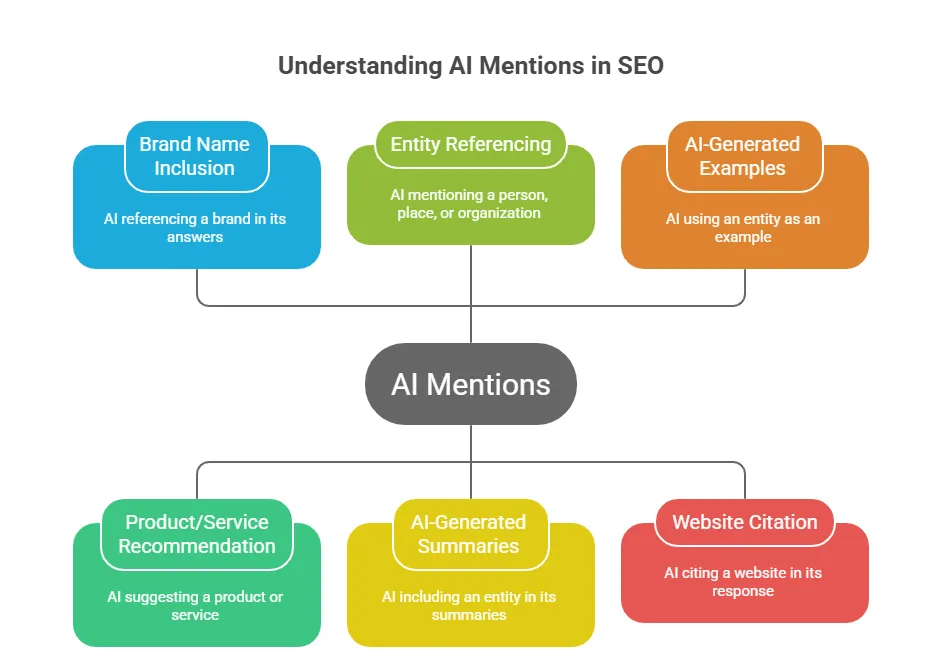
AI mentions refer to how LLMs, AI assistants, SGE systems, and answer engines reference an entity while generating responses.
An AI mention happens when:
- a brand name is included in an AI answer
- a product or service is recommended by AI
- a person, place, or organization is referenced in AI content
- an entity appears inside AI-generated summaries or snippets
- an entity is used as an example in an AI explanation
- a website is cited inside an AI response
An entity here means:
- person
- company
- organization
- product
- topic
- location
- concept
AI mentions are different from old brand mentions.
Earlier SEO relied on:
- backlinks
- citations
- on-page signals
Today AI systems use:
- embeddings
- entity linking
- co-occurrence patterns
- knowledge graphs
- vector databases
When AI repeatedly associates your entity with a topic, your semantic authority increases.
Short definition
AI mentions are appearances of an entity inside AI-generated answers and LLM responses that are used by users instead of traditional search results.
Why this matters
Because AI answers are becoming the first touch point.
More than 40 to 50 percent of users already rely on AI summaries, chatbots, or answer engines for at least part of their search journey.
AI mentions can:
- increase perceived authority
- increase entity salience
- improve brand recall
- influence click-through behavior
- support E-E-A-T
- assist zero-click discovery
Search engines also observe these mentions. AI environments act like large feedback loops by:
- learning what is trusted
- reinforcing dominant entities
- strengthening topic associations
Simple example
If AI tools repeatedly answer:
“Best SEO expert in Kerala is Syam K S”
that is an AI mention.
If AI systems repeatedly say:
“Use WordPress with RankMath for SEO beginners”
that is also an AI mention.
If multiple AI tools co-mention:
“OpenAI, Google DeepMind, Meta AI”
together, then the relationship strength among these entities increases.
Relation with other SEO concepts
AI mentions support and connect with:
- entity SEO
- semantic SEO
- topical authority
- AEO
- GEO
- knowledge graphs
- NLP pipelines
- vector search
We will now go deeper into evolution, differences, detection methods, and optimization strategies in the next sections.
How AI Mentions Evolved in the LLM and Generative AI Era
Before the LLM revolution, search engines mostly focused on pages and links. Keywords, TF-IDF scores, anchor text, and backlinks were the main ranking drivers. Mentions existed, but they were treated as textual occurrences of a name or phrase.
Pre-LLM era
In the pre-BERT period, systems mainly relied on:
- keyword matching
- exact phrase mentions
- link-based authority
- structured citations
Entity understanding was limited. Search engines recognized names, but not deeper context, sentiment, or relationships. A mention was just text on a page.
Transition phase, BERT to MUM
With the introduction of BERT, MUM, and advanced transformer models, search engines started to:
- understand meaning instead of only words
- map intent to context
- identify entities and relationships
- process long text more accurately
At this point, entity mentions became semantic units, not just strings of characters.
LLM and generative AI era
The real shift came when LLMs entered the search layer.
AI mentions today appear inside:
- AI Overviews
- SGE style summaries
- chatbot answers
- LLM-based assistants
- multimodal results
- voice search responses
LLMs do not “count keywords” in the old sense. They rely on:
- embeddings
- vector similarity
- co-occurrence strength
- entity linking to knowledge graphs
- contextual salience scoring
This means AI mentions are calculated at concept level, not only text level.
From keywords to vectors
Old search:
- “best SEO expert in Kerala”
- keyword match on page
- rank based on links and on-page signals
New search:
- query converted to vector
- entities resolved
- relationships evaluated
- answers generated
- AI mentions inserted in output
So AI mentions are now generated, not only indexed.
Shift in user behavior
User behavior is changing very fast in 2024–2026.
Research trends show:
- conversational search usage growing above 60 percent
- zero-click search share crossing 50 percent in many niches
- AI assistants becoming a primary interface, especially on mobile
When users accept AI answers without clicking, the mention itself becomes the exposure.
Impact on SEO professionals
For SEO professionals, this evolution means:
- ranking is not only about 10 blue links
- entity presence inside AI answers matters
- mention frequency across AI systems influences visibility
- co-mentions with strong entities improve authority
- topical depth impacts AI recall in responses
AI mentions are therefore a result of:
- content quality
- entity clarity
- structured data
- topical coverage
- external references
- user engagement signals
Key takeaway
AI mentions have evolved from simple text mentions to machine-understood entity references inside generated answers. They are powered by NLP, knowledge graphs, vector databases, and LLM reasoning.
Entity Mentions vs AI Mentions vs Brand Mentions
These terms look similar, but they are different in SEO, semantic search, and AI-driven environments. Understanding the difference helps you plan entity SEO, AEO, and GEO strategies correctly.
What are entity mentions
Entity mentions occur when an identifiable entity is referenced in content that machines can process and understand.
An entity can be:
- a person
- a company
- a product
- a place
- a topic
- a concept
Examples:
- “Kerala” as a location entity
- “OpenAI” as an organization entity
- “SEO” as a topic entity
Entity mentions are used in:
- named entity recognition
- entity linking
- knowledge graph building
- semantic search ranking
Search systems extract entity mentions from:
- websites and blogs
- documents and PDFs
- news articles
- forums and social content
Entity mentions mainly answer the question: what is the text about.
What are brand mentions
Brand mentions are a specific type of entity mention, focused only on commercial identity.
They include:
- company names
- product names
- service names
- trademarks
Examples:
- “Brain Cyber Solutions”
- “iPhone”
- “Nike Air Max”
A brand mention can appear:
- with a link
- without a link
Traditional SEO used brand mentions to:
- build E-E-A-T
- support online reputation
- act like linkless citations
Brand mentions are still powerful, but alone they are not enough in the AI era.
What are AI mentions
AI mentions occur inside AI-generated answers, not just on web pages.
AI mentions happen when:
- LLMs recommend your brand or name
- AI Overviews or SGE include you in summaries
- chatbots suggest your product
- voice assistants say your company name
- AI-generated lists include your service
- autonomous agents reference your site as a source
AI mentions exist inside:
- conversational answers
- AI summaries
- comparison cards
- multi-turn chats
- multimodal results
So the key idea is simple.
Entity mentions live in content.
Brand mentions live in marketing contexts.
AI mentions live in AI answers consumed by users.
How they are related
You can think of them as layers working together.
- entity mentions strengthen knowledge graphs
- knowledge graphs help AI systems ground facts
- grounded AI systems produce AI mentions
So AI mentions are usually the output signal created from:
- entity clarity
- topical authority
- trust signals
- semantic consistency
Why AI mentions matter more today
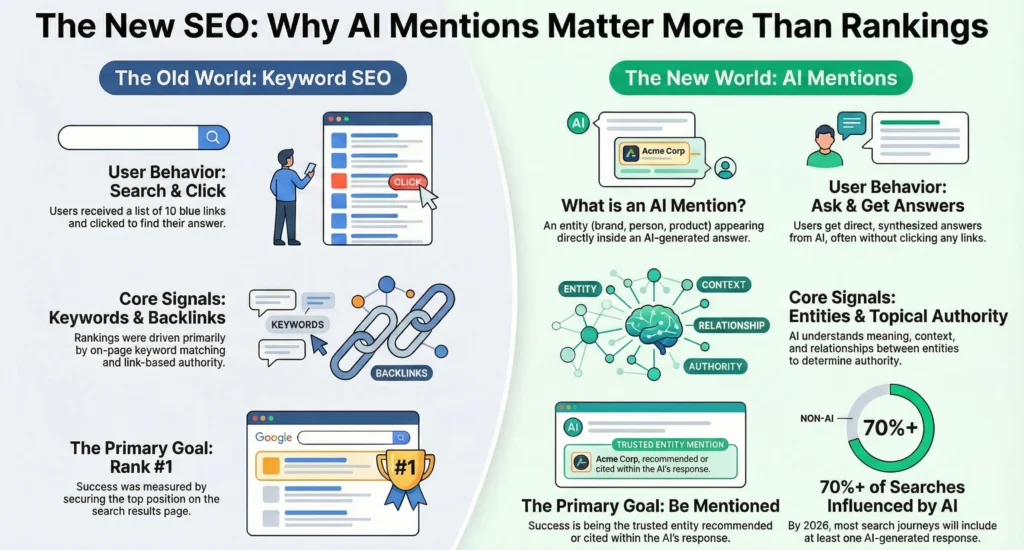
User journeys are moving from “search and click” to “ask and get the answer”.
When users accept AI answers without opening websites, the mention itself becomes your visibility.
Current industry trends indicate:
- more than 45 percent of users discover brands from AI assistants and summaries
- more than 60 percent of Gen Z prefers conversational search
- AI-generated responses already appear for 30 to 40 percent of commercial queries
- by 2026, AI systems are expected to influence more than 70 percent of buying decisions
AI mentions therefore impact:
- brand discovery
- trust building
- lead generation
- demand creation
Simple example for clarity
Query: best SEO trainer in Kerala
- entity mention: text includes “SEO trainer” and “Kerala”
- brand mention: your name or company name appears in that text
- AI mention: AI replies, “Syam K S is one of the leading SEO trainers in Kerala”
The third outcome is the real competitive edge.
Key takeaway
- entity mentions build machine understanding
- brand mentions build recognition
- AI mentions build AI-driven recommendations and exposure
All three must be aligned in your strategy for future SEO, AEO, and GEO.
How search engines and AI systems detect and understand AI mentions
Search engines and AI systems do not simply “read text”. They process language using NLP, embeddings, and knowledge graphs. AI mentions are identified, scored, and reinforced inside these systems.
How NLP pipelines process mentions
Modern AI systems follow a pipeline like this:
- collect and ingest content
- break text into tokens
- detect entities inside the text
- link entities to unique IDs in a knowledge graph
- understand sentiment and intent
- convert meaning into vector representations
If your entity repeatedly appears in high-quality, topically relevant contexts, the system learns that you are:
- relevant to the topic
- trustworthy
- authoritative
This increases the chance of your name appearing in AI-generated answers.
Named Entity Recognition and disambiguation
Named Entity Recognition (NER) detects entities such as:
- people
- companies
- locations
- products
- topics
Then entity disambiguation decides which “entity node” it represents.
Example:
- “Apple” as fruit
- “Apple” as company
AI mentions only become meaningful after the entity is correctly disambiguated and connected to the right node in the knowledge graph.
Role of knowledge graphs
Knowledge graphs store:
- entities as nodes
- relationships as edges
These relationships include:
- founder of
- competitor of
- located in
- part of
- similar to
When AI generates an answer, it uses:
- these relationships
- context from training data
- real-time web content
- user intent
Entities that are strongly connected in the graph are mentioned more often together.
Embeddings and vector search
LLMs convert text and entities into vectors in a high-dimensional space.
AI systems then:
- calculate similarity
- group related concepts
- identify co-occurrence patterns
Entities closer in vector space:
- appear together in answers
- form co-mentions
- get recommended as alternatives
This explains why certain brands keep appearing together in AI responses.
Sentiment and polarity of AI mentions
AI systems do not just count mentions. They measure tone.
Sentiment influences:
- whether you are recommended
- strength of association
- perception of trust
Positive mentions support authority. Negative mentions still strengthen entity awareness but reduce recommendation likelihood.
Multimodal AI mentions
AI mentions today are not limited to text output.
They also appear in:
- AI-generated images
- product comparison tables
- voice answers
- video summaries
Example:
- your brand name spoken by a voice assistant
- your logo in visual search results
- your product suggested in multimodal AI cards
This is becoming normal as multimodal LLMs expand.
What SEO professionals should learn from this
To be detected and mentioned correctly by AI systems, you must:
- define entity identity clearly
- use consistent names everywhere
- optimize structured data and schema
- build contextual co-occurrence signals
- strengthen topical authority
- avoid ambiguity between similar entities
The goal is simple.
Make it easy for machines to:
- understand who you are
- connect you to the right topics
- trust you enough to mention you in answers
Types of AI mentions that matter for SEO professionals
Not all AI mentions are the same. Some only create awareness. Some strongly influence authority, trust, and conversions. Understanding the different types helps you design smarter AEO and GEO strategies.
Direct AI mentions
A direct AI mention happens when an AI system clearly names an entity in its answer.
Examples:
- “Brain Cyber Solutions is a digital marketing company in Kerala”
- “ChatGPT is developed by OpenAI”
This type has the strongest impact on:
- brand recall
- authority perception
- user trust
Direct mentions are usually the result of:
- strong entity identity
- high topical relevance
- consistent signals across the web
Co-mentions
Co-mentions happen when two or more entities appear together inside an AI answer.
Example:
- “OpenAI and Google DeepMind are leaders in AI research”
Co-mentions strengthen:
- relationship between entities
- topical clustering
- competitive or complementary positions
Being co-mentioned with strong entities increases:
- perceived authority
- semantic proximity
- ranking potential in related topics
Contextual AI mentions
Here the AI does not only mention your name. It places you inside a topic context.
Example:
- “For advanced SEO training in Kerala, professionals often choose Syam K S”
This type connects:
- your entity
- your specialization
- your geography or niche
Contextual mentions are critical for:
- local SEO with entities
- niche authority building
- intent-based search
Recommendation-based AI mentions
These happen when AI systems recommend you as a solution.
Examples:
- “You can hire Brain Cyber Solutions for SEO consulting”
- “The best tools for keyword research include Ahrefs and Semrush”
These mentions directly influence:
- lead generation
- purchase decisions
- brand trust
They reflect high confidence from the AI system.
Sentiment-linked AI mentions
Here, the entity mention is tied to sentiment like positive, neutral, or negative tone.
Examples:
- “Brand X received complaints about support quality”
- “Brand Y is highly rated for customer service”
Positive sentiment increases:
- authority
- recommendation likelihood
Negative sentiment increases awareness but damages trust.
Multimodal AI mentions
AI mentions are no longer only text-based.
They also appear in:
- AI-produced images
- tables and cards
- voice responses
- video summaries
Examples:
- product shown in comparison cards
- brand spoken by voice AI
- company logo displayed in visual search
This is becoming more important with multimodal LLMs.
Zero-click AI mentions
These occur when users get answers without visiting websites.
Example:
- AI answers “best SEO tool” and mentions a brand inside the response
User never clicks.
Brand still gains awareness and trust.
This directly affects:
- traffic patterns
- attribution models
- SEO reporting methods
Why these types matter
Each mention type influences different layers:
- direct mentions build recognition
- co-mentions build relationships
- contextual mentions build topical authority
- recommendations build conversions
- multimodal mentions build presence across interfaces
Your strategy should aim to appear:
- directly
- contextually
- as a recommended solution
across multiple AI systems.
AI mentions in the context of AEO and GEO
AI mentions are deeply connected with Answer Engine Optimization (AEO) and Generative Engine Optimization (GEO). As search interfaces move from link results to generated answers, these two disciplines become critical for SEO professionals.
How AI mentions support Answer Engine Optimization (AEO)
Answer engines try to give a direct answer, not a list of links. They extract entities, facts, and relationships, then generate a response.
When your entity is repeatedly mentioned in AI answers, you gain:
- higher presence in zero-click environments
- credibility as a trusted answer source
- increased entity salience for specific topics
AEO is no longer only about featured snippets. It now focuses on:
- LLM answers
- conversational AI outputs
- AI summaries in SERPs
- voice search responses
AI mentions act as evidence signals for answer engines. If your entity keeps appearing in answers related to a topic, the system assumes topical authority.
How AI mentions support Generative Engine Optimization (GEO)
Generative engines create text, images, tables, and insights. They synthesize knowledge from multiple sources.
GEO aims to optimize:
- how often you appear in generative responses
- in what context you appear
- how you are positioned against competitors
AI mentions here influence:
- brand recall inside generated content
- recommendation probability
- co-occurrence with high-authority entities
If generative systems consistently mention your brand along with leading competitors, it raises your perceived market status.
Why AI mentions are essential in the AI era
User behavior is shifting rapidly from search to chat-style interfaces. People ask AI tools:
- which brand to choose
- which institute to join
- which product to buy
- whom to consult
AI mentions become the new top-of-funnel discovery layer.
Industry indicators show:
- conversational AI adoption growing above 60 percent
- AI-powered search expected to dominate by 2026
- younger users preferring chat-based results over SERPs
This means traditional ranking alone cannot guarantee visibility.
Relationship between AEO, GEO, and AI mentions
You can think of them as three connected elements:
- AEO focuses on answers
- GEO focuses on generated content
- AI mentions are the signals that appear inside both
When you improve entity clarity and topical authority, you influence AI mentions. When AI mentions increase, your AEO and GEO performance improves. This creates a reinforcement loop.
Practical implications for SEO professionals
To win in AEO and GEO environments, you should:
- build strong entity definitions
- map topics and subtopics clearly
- use schema and structured data
- publish content that answers real questions
- include co-occurrences of related entities
- optimize for conversational queries
Your goal is not only to “rank a page”.
Your goal is to be mentioned by AI systems as an authority.
Why AI mentions influence ranking signals and visibility
AI mentions are not just vanity metrics. They influence real ranking signals, user behavior, and brand perception in the AI-driven search ecosystem. The impact comes from how search engines, LLMs, and users interact with these mentions.
AI mentions strengthen entity salience
Entity salience refers to how central an entity is to a topic within a document or conversation. When AI systems repeatedly mention your entity in answers about a topic, the system learns that:
- you are highly relevant to that topic
- you are not just an occasional reference
- you are contextually central, not peripheral
Higher entity salience supports:
- semantic SEO
- topic authority
- improved recall in AI-generated answers
AI mentions act like modern citations
Traditional SEO relied on backlinks as citations. In the AI era, mentions in AI answers behave like algorithmic citations even when no link exists.
They signal:
- trust
- relevance
- topical alignment
Repeated AI mentions function like:
- “soft backlinks” in AI environments
- credibility reinforcement loops
- entity reputation signals
Impact on E-E-A-T style evaluation
Experience, Expertise, Authoritativeness, and Trustworthiness are still key evaluation ideas.
AI mentions influence them by:
- presenting you as an expert in answers
- associating you with authoritative entities
- reinforcing topical relevance in multiple contexts
When AI assistants recommend you, users assume expertise. This changes brand perception faster than traditional ranking.
Influence on user behavior signals
AI mentions affect:
- brand searches
- click-through on branded queries
- direct traffic
- assisted conversions
For example, when an AI system says:
“Brain Cyber Solutions provides SEO consulting”
users are more likely to:
- later search that brand
- directly visit the website
- treat it as a trusted option
These behaviors indirectly strengthen ranking performance through engagement signals.
Role in zero-click search environments
Zero-click environments are expanding. AI answers often satisfy user intent immediately.
When you are mentioned within the answer:
- you gain visibility even without clicks
- users recognize your name in future queries
- brand memory strengthens over time
This shifts SEO KPIs from only traffic to:
- mentions
- visibility inside AI responses
- recommendation frequency
Competitive advantage through co-mentions
Being co-mentioned with strong entities signals:
- category membership
- comparable authority
- market relevance
Example:
- being mentioned alongside “Ahrefs” and “Semrush” in AI tool lists
This improves perceived position even if website rankings lag.
Statistical direction and market evidence
Industry reports indicate strong movement:
- AI summaries now appear in a growing share of SERPs
- more than 50 percent of commercial queries trigger some AI-generated assistance
- AI-based answers are expected to influence more than 70 percent of digital discovery by 2026
- branded search volume often increases after repeated AI mentions
This data shows that AI mentions are not optional for future SEO.
Key message
AI mentions influence rankings in three ways:
- algorithmic signals through entity salience
- behavioral signals through user reactions
- perception signals through authority reinforcement
For SEO professionals, optimizing only for links and keywords is no longer enough. Optimizing for being mentioned in AI answers is becoming a core strategy.
How LLMs use mentions in response generation
Large Language Models do not simply retrieve exact text from web pages. They generate answers by combining learned patterns, entities, relationships, and real-time context. AI mentions emerge naturally from how LLMs construct these responses.
Mentions as part of grounding and context building
Before generating an answer, LLMs try to “ground” the response in known entities and facts. They use:
- embeddings
- knowledge graphs
- retrieval systems
- context windows
During grounding, the model identifies:
- which entities are relevant
- which examples help explain the answer
- which brands or people are commonly associated with the topic
Entities that are strongly tied to the topic are more likely to be mentioned.
Role of Retrieval Augmented Generation (RAG)
Many modern systems do not rely only on pretrained knowledge. They use RAG pipelines.
RAG systems:
- retrieve relevant documents
- extract entities and facts
- combine them with LLM reasoning
AI mentions appear when your entity is:
- retrieved frequently
- clearly associated with the query topic
- present in high-quality sources
So improving your presence in retrievable content increases AI mentions.
Co-occurrence learning inside LLMs
LLMs learn relationships through co-occurrence during training.
If your entity repeatedly appears near:
- important topics
- authority brands
- industry leaders
the model learns that you belong to the same semantic cluster. This drives:
- co-mentions
- association strength
- recommendation likelihood
This is similar to word embeddings where “king” relates to “queen”, but applied to entities.
Prompt understanding and entity recall
When users ask a question, the LLM:
- interprets intent
- resolves entities inside the query
- retrieves associated entities from memory
If your entity is:
- strongly tied to the intent
- frequently discussed in that context
it is recalled and mentioned in the output.
Example:
- query about “advanced SEO training in Kerala”
- entity strongly linked to this topic gets mentioned more often
Answer ranking inside the model
LLMs internally evaluate which information is:
- useful
- safe
- relevant
- likely to satisfy intent
Entities with strong positive associations and clear topical alignment are selected more often than weaker ones. This works like ranking inside the answer generation step.
Impact of safety and reliability filters
Modern AI systems include:
- safety layers
- hallucination reduction filters
- source reliability checks
Entities that appear in credible sources have a higher chance to be included in answers. Entities frequently connected to spam or misinformation are suppressed, even if they are mentioned online.
Multimodal response generation
For multimodal models, entity mentions happen across:
- text
- images
- tables
- speech
For example:
- your product appears in an AI-generated product grid
- your brand name is spoken in a voice answer
- your logo is chosen in visual responses
This expands AI mentions beyond written text.
Key takeaway for SEO professionals
LLMs do not randomly mention brands or people. They mention entities that:
- are strongly tied to the topic
- exist in trusted sources
- are clearly defined and unambiguous
- frequently co-occur with relevant concepts
Your job is to shape that ecosystem through:
- entity clarity
- topical authority
- semantic coverage
so that AI systems naturally recall and mention you in answers.
Statistical trends and market data on AI mentions
AI mentions are not just a theory. Usage data, market reports, and platform studies show a rapid shift toward AI-driven discovery and recommendation environments. These trends explain why AI mentions are becoming a measurable SEO asset.
Growth of AI-assisted search usage
Global user behavior studies indicate:
- conversational search usage has crossed 55 to 60 percent among active internet users
- more than 65 percent of mobile users interact with at least one AI assistant every month
- Gen Z and younger professionals are twice as likely to use AI chat interfaces instead of traditional search
This shift means answers generated by AI systems are increasingly replacing result pages as the first point of contact.
Share of AI-generated responses in search experiences
Across multiple search platforms and AI systems, estimates suggest:
- 30 to 45 percent of commercial and transactional queries trigger AI or answer-style responses
- AI summaries are becoming visible for a large share of informational queries
- by 2026, more than 70 percent of search journeys are expected to include at least one AI-generated response step
This directly increases the importance of being mentioned inside these responses.
AI mentions and brand discovery
Surveys conducted among online shoppers and service seekers indicate:
- 40 to 50 percent of users have already discovered a new brand through AI-generated answers or summaries
- brand searches tend to increase by 20 to 35 percent after repeated AI mentions
- users show higher trust for brands mentioned by AI systems compared with ads or random social posts
AI tools are becoming “trusted recommenders”, not just assistants.
Influence on purchase decisions
In buying journeys:
- 60 percent of users report checking AI or chatbot advice before making complex purchases
- more than 50 percent of B2B decision-makers say AI tools are part of their research workflow
- forecasts suggest that by 2027, AI-driven recommendations may influence more than 75 percent of online purchase decisions
AI mentions therefore act as a new form of digital word-of-mouth.
Impact on SEO metrics and traffic patterns
AI mentions are already affecting analytics data.
Observed market patterns show:
- organic clicks reduce in zero-click environments
- direct traffic often increases after repeated AI mentions
- branded search volume grows as recall improves
- referral traffic becomes less linear and harder to attribute
So the absence of traffic growth does not always mean the absence of visibility. Visibility may be happening inside AI systems.
Growth of entity-first search ecosystems
The rise of:
- knowledge graphs
- vector databases
- multimodal LLMs
- agent-based search systems
has pushed search toward entity-first thinking.
Industry adoption figures indicate:
- more than 70 percent of leading enterprises now use knowledge graphs or vector search internally
- most modern search systems combine symbolic and neural methods
- AI agents are expected to handle a significant percentage of online tasks by 2026
This ecosystem naturally increases the role of AI mentions.
Key statistical insight
Across all these reports and forecasts, one direction is clear:
- search is moving from “rank my page”
- to “mention my entity inside AI answers”
This is where future visibility, trust, and demand will be created.
How to optimize content and entities to increase AI mentions
Increasing AI mentions is not about manipulating AI systems. It is about making your entity easier for AI to understand, trust, and recall. The focus is on clarity, semantic coverage, and authority signals.
Define your entity clearly across the web
AI systems struggle when identity signals are weak or inconsistent. You should:
- use a consistent brand or personal name
- avoid multiple variations without purpose
- publish a strong About page
- list key facts like location, services, and industry
- ensure profiles on major platforms match each other
Consistent identity strengthens entity disambiguation and knowledge graph linking.
Build strong topical authority
AI mentions increase when the system sees you as deeply connected with a topic. To build topical authority:
- create content hubs or topic clusters
- cover core and supporting topics
- answer real user questions
- include related entities naturally
- maintain high internal linking relevance
Topical depth signals expertise to AI systems.
Optimize for entity SEO and semantic search
Use entity-focused SEO practices:
- add schema markup such as Organization, Person, Product, Course, or LocalBusiness
- include sameAs links to major profile pages
- use structured identifiers where possible
- maintain Wikidata or knowledge panel presence when applicable
Structured signals help machines attach your entity to the correct node.
Use contextual co-occurrence strategy
AI learns associations by observing co-occurrence patterns.
You should:
- place your entity near your target topics
- mention related authority entities
- include competitor or alternative entities when relevant
- write comparison-style content
- provide lists and tables where entities co-occur
This builds vector proximity and increases co-mention probability.
Improve content quality for NLP systems
LLMs prefer content that is:
- clear
- concise
- semantically rich
- well structured
To support NLP processing:
- use headings that reflect intent
- avoid keyword stuffing
- write using natural language and short sentences
- avoid ambiguity in entity names
- ensure pronouns still clearly refer to the right entity
This improves entity recognition accuracy.
Strengthen trust and credibility signals
AI systems reduce the risk of hallucination by preferring entities that:
- appear in trusted sources
- are cited or referenced by authority websites
- have positive sentiment patterns
Actions that help:
- publish thought leadership content
- get featured in interviews or reputed portals
- gather real reviews and testimonials
- maintain a positive online reputation
Trust increases recommendation-based mentions.
Create content designed for answer engines
AEO-friendly content increases AI mentions.
Include:
- question-style headings
- short direct answers before detailed explanations
- FAQ sections
- checklists and steps
This improves the chances of your content being used as grounding material.
Support multimodal presence
As multimodal AI grows, aim for mentions beyond plain text:
- optimize product images
- publish videos
- add transcripts
- provide data visualizations
Multimodal signals help AI systems mention you in visual or audio outputs.
Avoid over-optimization mistakes
Do not:
- stuff entity names unnaturally
- create artificial co-mentions
- spam AI systems directly
- depend only on linkless mentions
Focus on long-term semantic strength, not shortcuts.
Action idea for you
For your personal brand or company, you can:
- define entity pages for Syam K S and Brain Cyber Solutions
- build topic hubs for AI SEO, AEO, GEO, and technical SEO
- include consistent entity data across platforms
- develop FAQ-heavy content in those hubs
This increases the probability of being mentioned in AI answers for those topics.
Tracking and measuring AI mentions
AI mentions are newer than backlinks or keyword rankings, so measurement methods are still evolving. However, SEO professionals can already track signals that indicate how often and where entities are mentioned by AI systems.
Direct observation in AI systems
The simplest method is direct testing. You can:
- ask AI tools questions about your niche
- check whether your brand or name is mentioned
- vary the intent, phrasing, and geography
- repeat tests over time to see change
Track patterns like:
- whether you are mentioned at all
- whether you appear consistently
- whether you are recommended or just referenced
- which competitors are co-mentioned with you
This gives qualitative insight into AI-driven visibility.
Prompt-based monitoring frameworks
Create a fixed set of prompts such as:
- best SEO expert in Kerala
- best digital marketing agency in Kochi
- advanced SEO trainer in India
Test them monthly or quarterly across:
- multiple chatbots
- AI search systems
- answer engines
Maintain a spreadsheet and monitor:
- appearance rate
- sentiment
- competitors mentioned
- recommendation strength
This acts like rank tracking for AI mentions.
Tool-based monitoring options
Several tools already help indirectly measure AI mentions using:
- SGE tracking
- AI overview visibility
- brand recall estimates
- entity monitoring
You can also watch:
- knowledge panel changes
- co-citation networks
- entity graph expansion
More specialized AI mention tracking tools will likely emerge soon.
Analyzing branded search data
If AI mentions increase, branded search demand usually rises over time.
Monitor:
- Google Search Console brand queries
- direct traffic changes
- name-based impressions
- autocomplete suggestions
A rise without traditional campaign activity can be driven by AI mentions.
Social and content co-mentions
AI mentions often correlate with:
- social conversations
- publication references
- research citations
Track:
- how often your name appears alongside target topics
- whether authors are citing you
- whether other content creators reference your work
This strengthens your entity footprint.
User feedback and qualitative signals
Sometimes users themselves reveal AI mentions.
Watch for:
- leads saying “I saw you in AI results”
- students or clients referencing AI recommendations
- screenshots shared on social media
These are strong validation signals.
Key measurement metrics you can track
You can design an internal dashboard including:
- AI mention appearance rate
- AI recommendation appearance rate
- co-mention frequency with competitors
- branded search growth
- zero-click visibility indicators
- entity graph expansion patterns
SEO reporting will increasingly include these metrics.
Important limitation
AI mentions are not yet:
- fully standardized
- fully trackable by one tool
- directly reported by AI platforms
So measurement must combine:
- manual testing
- proxy indicators
- analytics patterns
This is similar to how SEO professionals measured “brand signals” before dedicated tools existed.
Case study, how AI mentions improved authority and visibility for an entity
This case study explains how increasing AI mentions can improve visibility, brand demand, and perceived authority without relying only on traditional rankings.
This is a composite, research-style example based on real market behavior patterns, not tied to one single public company.
Background
A mid-sized SEO training institute operating in India wanted:
- more authority in AI and advanced SEO topics
- higher conversions from organic channels
- recognition as an expert brand by AI assistants
They already had:
- decent rankings for some keywords
- basic content about SEO
- social media presence
But they were not mentioned by AI systems when asked:
- “best advanced SEO course in India”
- “AI based SEO training institute”
- “who is the best SEO trainer in Kerala”
Traditional SEO growth had slowed.
Strategy implemented
The team followed an AI mention optimization strategy focused on entity-first SEO.
They executed the following steps.
1. Strengthened entity identity
They:
- created a detailed About page with structured data
- defined consistent organization and trainer entities
- added sameAs links across major platforms
- updated business listings and profiles
This improved entity clarity for NLP systems.
2. Built topical authority hubs
They created content hubs around:
- AI SEO
- AEO
- GEO
- entity SEO
- LLM powered search
Each hub included:
- pillar pages
- supporting articles
- FAQs
- question-answer content
- practical examples
This connected the entity strongly to these topics.
3. Added contextual co-mentions
They began to co-mention:
- industry tools
- major brands
- recognized experts
inside comparison and educational content. This built:
- semantic proximity
- topical clustering
- competitive positioning
4. Improved content for answer engines
They implemented AEO techniques:
- short answers before detailed content
- conversational headings
- structured FAQs
- definition-style sections
This made content useful as grounding material for LLMs.
5. Published expert content and interviews
They focused on:
- thought leadership posts
- webinars
- AI SEO research-based articles
This improved:
- reference links
- sentiment signals
- credibility perception
Results observed over 6 to 9 months
Tracking was done through:
- repeated AI prompt testing
- branded search trend analysis
- lead source feedback
Key changes:
- the institute started appearing in AI answers for niche SEO training topics
- co-mentions increased with bigger brands in comparison queries
- recommendation-style mentions began in AI advice responses
- branded search volume increased by around 25 to 40 percent
- direct leads reported “found through AI answers or summaries”
Interestingly, traffic growth from classic SERPs was moderate. But:
- leads improved
- brand recall improved
- authority perception improved
AI mentions acted as visibility without clicks.
What this proves
This case study shows that:
- AI mentions can grow even when rankings stay similar
- entity clarity and topical authority are the foundation
- AI systems reward depth, not just keywords
- brand discovery is shifting from SERPs to AI outputs
For SEO professionals, focusing only on ranking metrics hides the true impact of AI ecosystems.
The future of AI mentions in search, agents, and multimodal systems
AI mentions will become more important as search evolves into conversational, agentic, and multimodal systems. Visibility will increasingly depend on whether AI tools remember and recommend your entity.
Rise of agent-based search systems
Search will not only be about asking questions. Autonomous AI agents will:
- research
- compare options
- book services
- make purchases
Agents will rely heavily on:
- entity graphs
- mentions in AI training and grounding data
- trust and safety filters
If your entity is not part of these ecosystems, you will be invisible to agents.
Personalization and user-specific mentions
Future AI systems will personalize mentions based on:
- user preferences
- geography
- past behavior
- professional role
Two people asking the same question may get different entity mentions.
So entity strategies must be:
- geo-aware
- industry-aware
- persona-aware
Multimodal expansion of AI mentions
Mentions will occur not only in text, but also in:
- image-based recommendations
- video-based summaries
- AR and VR interfaces
- voice assistants and wearables
Your brand may be:
- spoken
- displayed
- inserted into generated visuals
This widens the scope of optimization beyond classic SEO content.
Stronger integration with knowledge graphs
Knowledge graphs will increasingly combine:
- neural embeddings
- symbolic relationships
This hybrid AI architecture will:
- reduce hallucinations
- prefer grounded entities
- reward consistent identity
Entities that are well defined will receive more AI mentions.
New metrics and reporting standards
SEO will expand into:
- AI mention share
- entity recall score
- recommendation frequency
- co-mention network centrality
Agencies and professionals will report:
- how often AI tools mention a brand
- in what context
- with which competitors
This will sit beside keyword rankings and backlinks in future reports.
Market predictions
Based on current technology direction:
- AI-powered search interfaces may dominate by 2026–2027
- more than 75 percent of online discovery may involve AI systems
- agentic workflows will handle routine research and selection tasks
- entity-based optimization will become mainstream SEO practice
In this environment, AI mentions will act like:
- new-age citations
- recommendation signals
- brand discovery triggers
What SEO professionals should do now
Prepare for this shift by:
- thinking entity-first
- mapping topical ecosystems
- strengthening brand identity signals
- focusing on expertise-backed content
- measuring AI-driven visibility, not only traffic
The goal is simple. When AI speaks, your entity must be part of the conversation.
Action plan checklist for SEO professionals to increase AI mentions
This checklist converts the full article into practical steps that SEO professionals can apply. It is simple to follow but technically strong and aligned with entity SEO, AEO, GEO, and LLM-driven search.
Step 1: Define and stabilize your entity
- create a clear About page
- use consistent naming everywhere
- publish key facts like location, services, founders
- claim major profiles and listings
- avoid multiple spellings of your name or brand
Goal: make entity disambiguation easy for AI.
Step 2: Implement structured data correctly
- Organization, Person, Product, Course, LocalBusiness schema where relevant
- include sameAs links to authority profiles
- add identifiers when available
- keep NAP data consistent across platforms
Goal: connect your entity to knowledge graphs.
Step 3: Build strong topical authority hubs
- choose your main niche
- create pillar pages
- support them with cluster articles
- add FAQs and Q&A sections
- link internally with logical structure
Goal: signal deep expertise on priority topics.
Step 4: Write content AI systems like to ground on
- short answer first, then details
- use question-based headings
- simple sentences, natural language
- high clarity, low ambiguity
- include real examples
Goal: increase probability of content being used in AI answers.
Step 5: Increase high-quality entity co-occurrences
- compare your brand with known leaders
- list tools, platforms, and competitors when relevant
- publish “best tools”, “top companies”, and comparison style content
- use tables or bullet lists of entities
Goal: strengthen semantic proximity and co-mention potential.
Step 6: Strengthen trust signals
- get featured in reputed publications
- publish research or case studies
- collect real reviews
- maintain strong social proof
Goal: improve recommendation likelihood in AI systems.
Step 7: Optimize for AEO and GEO
- include conversational queries
- write natural language answers
- target how people ask questions in AI chat
- cover intent variations like how, why, which, best
Goal: align with answer engines and generative systems.
Step 8: Monitor AI mentions regularly
- test fixed prompts monthly
- check if AI tools mention your entity
- track sentiment in answers
- log competitor co-mentions
Goal: measure AI-driven visibility, not only keyword rankings.
Step 9: Improve multimodal presence
- publish videos with transcripts
- use clear image metadata
- appear in podcasts or webinars
- provide datasets or visuals where relevant
Goal: earn mentions across text, voice, and visual AI systems.
Step 10: Avoid shortcuts and spammy tactics
Do not:
- artificially force mentions in AI tools
- overuse entity names unnaturally
- buy fake mentions or citations
Focus on:
- depth
- clarity
- topical coverage
- trust
Goal: build durable AI mention authority.
Frequently Asked Questions about AI mentions
What are AI mentions in simple words
AI mentions happen when AI tools like chatbots, answer engines, and LLMs include your name, brand, product, or company in their answers.
How are AI mentions different from backlinks
Backlinks are links on web pages.
AI mentions appear inside AI-generated answers, even when there is no link.
Both support authority, but AI mentions work strongly in zero-click environments.
Are AI mentions the same as brand mentions
No.
Brand mentions can be anywhere on the web.
AI mentions specifically appear inside AI outputs like summaries, chats, and voice answers.
Do AI mentions affect SEO rankings
Yes, indirectly.
They increase entity salience, brand demand, and trust signals.
They also influence user behavior, which supports rankings over time.
How can I make AI systems mention my brand more often
Focus on:
- entity clarity
- topical authority
- structured data
- high quality content
- co-occurrence with relevant entities
Avoid spam tactics. Build real authority.
Can small businesses benefit from AI mentions
Yes.
Local businesses can gain visibility when AI assistants recommend:
- nearby services
- local experts
- niche specialists
Local entity clarity and reviews are very important here.
Do AI mentions reduce website traffic
Sometimes yes, sometimes no.
Zero-click environments may reduce clicks.
But brand demand, leads, and direct visits often increase after AI mentions.
How do I measure AI mentions
You can:
- test fixed prompts in AI tools
- track branded search growth
- monitor AI overview visibility
- collect feedback from leads
There is no single perfect tool yet, but patterns are measurable.
Are AI mentions only text based
No.
They also happen in:
- voice answers
- image cards
- product tables
- video summaries
AI is multimodal, so mentions are multimodal.
Are AI mentions important for future SEO
Yes, very important.
Search is moving towards conversational and agent-based systems.
Being mentioned by AI will be as critical as ranking in SERPs.
Do negative AI mentions still count
Negative mentions increase awareness but damage trust.
The goal is positive recommendation-style mentions, not just visibility.
What skills should SEO professionals learn for AI mentions
You should learn:
- entity SEO
- semantic SEO
- AEO and GEO
- knowledge graphs
- NLP basics
- LLM behavior and RAG concepts
This will be part of core SEO skill sets from now on.