
SEO Content Strategy Services in Kerala, India
I'm Syam K S, an SEO & AI Search Strategist from Ernakulam, Kerala. I build structured content systems that align with search intent, strengthen topical authority, and improve how both search engines and AI platforms understand your business.
I've worked in digital and search since 2001, and professionally in SEO and digital marketing since 2005. My approach begins by understanding the business entities and their relationships, then combines that foundation with keyword research, search intent and topic analysis to build the content architecture.
My Content Strategy Services
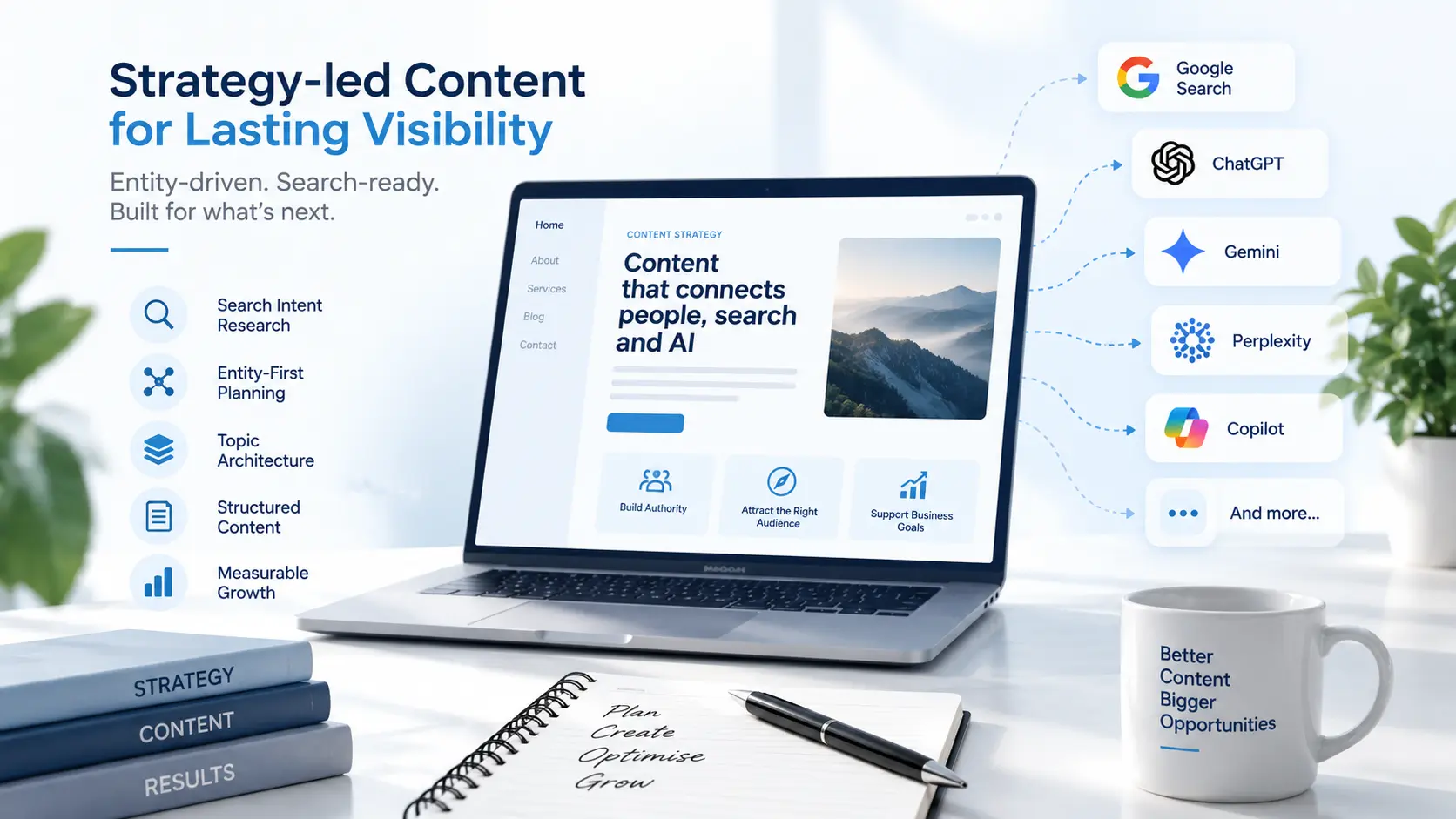
I build structured, measurable, search-aligned content systems rather than a schedule of articles. The goal is content that builds topic authority, reads clearly for people, and supports conversions through a deliberate content journey.
Search-Aligned Content Planning
I identify what your users actually search, how they phrase queries, and how those topics connect to your business goals.
Topical Authority Development
I map primary topics, supporting subtopics, related entities, and long-tail patterns that build authority and improve visibility across entire categories, not just individual keywords.
Page-Level Content Structuring
I define what information should appear on each page using structured sections, content hierarchy, and internal link logic to create high clarity.
Content Upgrade & Optimization
Instead of rewriting everything, I identify priority pages and upgrade them for better topical depth, search intent match, and conversion alignment.
Entity-First Content Architecture
Most content strategy starts with keywords, groups them into topics, and plans pages around those groups. That works, up to a point. The problem shows up later: search engines and AI systems still have to infer what your business actually is from whatever your pages happen to say, and different pages often imply different things.
I work the other way round. Before planning any content, I define the entity picture: what your organisation is, what it offers, who is behind it, how those things relate, and which of them you have genuine authority over. Content architecture then expresses that structure rather than accidentally contradicting it.
The EntityMap Specification
EntityMap is an open specification created by Fred Laurent and Dixon Jones, published under CC BY 4.0 at entitymap.org. It provides a structured, machine-readable format for declaring a site's entities and their relationships explicitly, in one place, rather than leaving them to be inferred from scattered page content.
No search engine consumes a custom specification natively, and EntityMap does not claim otherwise. What it does is force the entity picture to be defined, consistent, and available in a parseable form. Everything downstream, schema, internal linking, topic clusters, page hierarchy, then follows from a single declared source instead of drifting apart over time.
Why This Sequence Matters for AI Search
When a language model builds a description of your business, it is reconciling everything it can find. If your homepage, your service pages, and your author bios each describe you slightly differently, the model has no basis to state anything confidently, and the resulting summary is vague or wrong.
Entity-first architecture removes that ambiguity at the source. The same descriptions, the same relationships, the same claims, expressed identically everywhere. That consistency is what allows an AI system to describe your business accurately, and it is invisible work that keyword-led content planning never gets to.
My Strong SEO Content Strategy Areas
My approach focuses on structured planning, AI-readable content formats, and search intent clarity. Content needs to work for people reading it, for ranking algorithms, and for generative platforms like Gemini, ChatGPT, calude, Perplexity, and Google AI Overviews.
Topic Mapping & Intent Classification using NLP Signals
I identify primary topics, related entities, search variations, and meaning clusters using NLP-based analysis so your content aligns with actual user intent, not just keywords.
Framework Design from Topic to Page Level (AEO-Ready)
I convert broad topics into structured page-level layouts with sections that AI engines can extract as clear answers, improving visibility in summaries, snippets, and answer blocks.
Internal Link Logic That Supports Entity Depth
I design content relationships so each page reinforces a topic cluster rather than competing with it, helping build stronger entity connections across pages.
AI-Friendly Content Validation, GEO-Ready Formatting
I refine or restructure content so AI systems can summarise and reference it correctly. This improves visibility in conversational outputs and AI-based recommendation layers.
Why Content Strategy Matters Now
Search results are no longer a simple list of keyword matches. AI systems including Gemini, ChatGPT, Perplexity, and Google AI Overviews reformat content into summaries, answers, and conversational outputs. If content is not structured clearly, these systems may skip your brand, extract incomplete information, or reference a competitor instead.
This raises the cost of unstructured publishing. Without a clear strategy, businesses produce content that overlaps internally, competes with itself for the same queries, confuses readers, and gives search engines no coherent picture of topic depth. Rankings become unstable, visibility drops across whole categories, and the content budget produces pages rather than results.
There is also a change in what content has to survive. A page used to compete for a click. Now it also has to be clear enough that a machine can summarise it without distorting it, and specific enough that summarising it does not remove the reason to visit. Content that only restates what is already widely available gets absorbed into an AI answer and generates nothing.
Structured content planning built on entity relationships, NLP signals, AEO formats, and GEO readiness produces stable rankings, accurate representation in AI answers, and durable authority over topics. Every page supports intent, contributes to topic depth, and delivers measurable outcomes rather than volume.
What You Receive
Content strategy is easy to describe vaguely, so here is what the work actually produces.
Entity Map
A declared structure of your business, services, people, and their relationships, in a machine-readable format, with the consistent descriptions to be used across every page and profile.
Topic Architecture
Primary topics, supporting subtopics, and their relationships, mapped to specific URLs. This shows what exists, what is missing, what overlaps, and what should be merged or removed.
Page-Level Briefs
Section-by-section structure for priority pages: what each section covers, what question it answers, what entities it should reference, and how it links to the rest of the cluster.
Internal Link Plan
A defined linking structure so each page reinforces its cluster rather than competing with it, with anchor text specified rather than improvised.
Content Guidelines
Voice, formatting, and structural rules your writers can follow, including AEO formatting patterns and the entity descriptions that must stay consistent.
Measurement Framework
GA4 and Search Console configured to report topic-level performance rather than page-level noise, so you can see whether the topics are gaining ground rather than just whether traffic moved.
About Me, SEO & AI Search Strategist from Ernakulam. Kerala
I'm Syam K S, an SEO & AI Search Strategist from Ernakulam, Kerala, India. I've worked in digital and search since 2001, and professionally in SEO and digital marketing since 2005. I am the Founder and CEO of Brain Cyber Solutions, a Digital Marketing & SEO Company, and the founder of Maattam, an AI Learning & Professional Growth Ecosystem for Malayalam speakers. My work focuses on structured content systems, entity clarity, AI-ready formats, and measurable content performance, including implementing the EntityMap open specification for client sites. View more details about me
Frequently Asked Questions About Content Strategy
What is content strategy in SEO?
It is a structured plan for creating and organizing content based on search intent, topics, and business goals, rather than publishing content randomly.
How does a content strategist improve rankings?
By defining topic frameworks, search intent alignment, internal linking structure, and content hierarchy that improves topical authority and visibility.
What is topical authority and why is it important?
Topical authority means covering a subject in-depth across multiple connected pages. It helps websites rank strongly for an entire category of queries.
What is topic mapping?
Topic mapping identifies main categories, supporting subtopics, intent variations, and internal relationships to plan pages in a structured way.
Do you use AI tools for content planning?
Yes. I use AI-assisted tools to analyze intent gaps, cluster queries, plan content depth, and validate clarity and extractability for AI platforms.
What is AEO in content strategy?
AEO means Answer Engine Optimization. It helps content appear as direct answers in AI-generated results, summaries, and conversational search outputs.
What is GEO in content strategy?
GEO means Generative Engine Optimization. It focuses on structuring content so it can be summarised and referenced correctly by platforms like Gemini, ChatGPT, Perplexity, and Google AI Overviews. In content strategy terms, that means clear entity signals, self-contained sections, and information specific enough to be worth citing.
Can you improve existing content or do you only plan new content?
I upgrade existing content by improving structure, entity clarity, cross--referencing, and depth, and also plan new pages whenever needed.
Do you provide content writing also?
I provide strategic frameworks, section-level planning, page structure, and content guidelines. Writing can be done by your team or outsourced through experienced writers.
How do you measure content performance?
Performance is tracked using GA4, GSC, Looker Studio, and engagement analytics to measure visibility, click-through behavior, conversions, and topic-level reach.
How long does content strategy take?
The initial structure can be completed within 2–6 weeks depending on scope, and ongoing refinements happen monthly based on performance.
Do you support ecommerce websites?
Yes. I plan product--level content, category structuring, buyer-intent journey, and tracking layers for Shopify and WooCommerce platforms.
How is content strategy different from content marketing?
Content marketing is about producing and distributing content. Content strategy decides what should exist in the first place, how it connects, and why. Strategy comes first: without it, content marketing produces volume without direction, and most of the budget goes into pages that compete with each other.
Will AI replace the need for content strategy?
It does the opposite. AI has made producing content nearly free, which means volume no longer differentiates anyone. What differentiates is structure, accuracy, and genuine expertise, which are strategy problems rather than production problems. The easier content is to generate, the more the planning layer decides whether it works.
What is an entity map and why does my site need one?
An entity map declares what your business is, what it offers, who is behind it, and how those things relate, in a structured form rather than leaving it implied across dozens of pages. Search engines and AI systems build a picture of your business from whatever they can find. If your pages describe you inconsistently, that picture is unreliable. An entity map makes it explicit and consistent, which is increasingly what determines how accurately AI systems describe you.
Looking for Content Strategy Services in Kerala, India?
Share your domain and niche. I will assess your current content depth, identify strategy gaps, and recommend a structured content roadmap.
Contact Syam