
Search engines no longer rank only pages. They understand entities. An entity is a real-world object. It can be a person, company, place, or concept. Google’s search system is built on entities and relationships. The Knowledge Graph connects these entities.
If a person becomes a recognized entity, search engines trust the information around that person. This improves rankings, credibility, and visibility across search engines and AI systems.
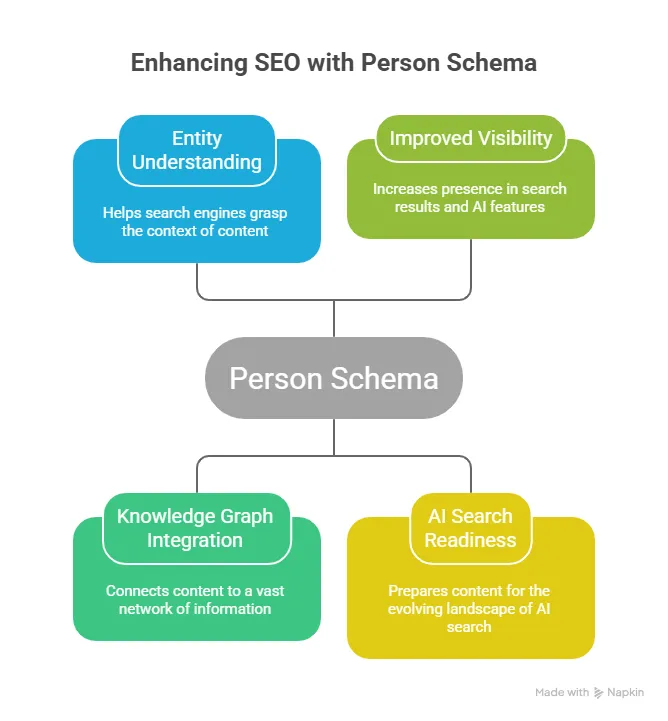
One powerful method to help search engines understand a person is Person Schema Markup. This article explains how Person Schema works.
It also explains its connection with Entity SEO, Semantic SEO, Knowledge Graphs, EAV models, EEAT, and AI search systems.
What is Person Schema?
Person Schema is structured data that describes a person.
It helps search engines clearly understand:
- Who the person is
- What they do
- Their expertise
- Their affiliations
- Their online presence
Person schema is written using Schema.org structured data, usually in JSON-LD format.
When implemented correctly, it helps search engines connect a person to other entities across the web.
This strengthens authority signals and improves EEAT signals.
Why Person Schema Matters for SEO
Modern search engines rely heavily on entity understanding.
According to Google research, the Knowledge Graph contains billions of entities and relationships.
Person schema helps search engines identify:
- The person behind the content
- Their expertise
- Their authority in a topic
This improves visibility in:
- Google Knowledge Panels
- AI generated answers
- AI Overviews
- Voice search
- Entity based search results
For SEO professionals, building a person entity has become critical.
Especially in the AI search era.
Understanding Entities and the EAV Model
Entity systems often use a structure called EAV.
EAV stands for:
Entity
Attribute
Value
This model helps machines store and understand structured information.
Example:
Entity: Syam K S
Attribute: Profession
Value: SEO Expert
Entity: Syam K S
Attribute: Company
Value: Brain Cyber Solutions
Entity: Syam K S
Attribute: Expertise
Value: Technical SEO
Search engines collect thousands of such signals.
They combine them into a knowledge graph profile of a person.
Person schema helps supply structured EAV data directly to search engines.
Entity SEO and Person Schema
Entity SEO focuses on making a brand or person a recognized entity.
Instead of optimizing only keywords, entity SEO optimizes identity and relationships.
Person schema helps define relationships such as:
- Person → Organization
- Person → Topic expertise
- Person → Social profiles
- Person → Published content
- Person → Awards and achievements
When these signals are consistent across the web, search engines build stronger entity confidence.
This improves:
- Topical authority
- Trust signals
- AI search visibility
Semantic SEO and Structured Data
Semantic SEO focuses on meaning and context.
Instead of isolated keywords, search engines evaluate:
- Entities
- Relationships
- Topic clusters
- Contextual meaning
Person schema contributes semantic signals such as:
- Job title
- Works for
- Area of expertise
- SameAs social profiles
- Author of content
These signals help search engines understand the semantic relationship between content and author.
This is important for author authority signals.
Person Schema and the Knowledge Graph
Google’s Knowledge Graph connects entities through relationships.
If a person becomes recognized as an entity, search engines may create a knowledge graph profile.
This may appear as a:
- Knowledge Panel
- Entity card
- AI generated profile summary
Person schema helps search engines verify:
- Identity
- Expertise
- Organizational relationships
- Official profiles
Consistent signals across:
- websites
- social profiles
- structured data
- publications
increase the probability of knowledge graph recognition.
Person Schema and EEAT
EEAT stands for:
Experience
Expertise
Authoritativeness
Trustworthiness
Google uses these signals heavily for evaluating content quality.
Person schema strengthens EEAT signals by clearly identifying the author.
Example signals:
- author name
- job title
- organization
- expertise
- professional background
- official profiles
This helps search engines verify that the content is written by a real expert.
In AI search systems, this becomes even more important.
Person Schema in the AI Search Era
AI search engines rely heavily on structured knowledge.
Examples include:
- Google AI Overviews
- ChatGPT browsing systems
- Perplexity AI
- Bing Copilot
These systems often retrieve information from:
- knowledge graphs
- structured data
- authoritative sources
Person schema improves the chances that AI systems recognize a person as a credible source.
Benefits include:
- Higher probability of AI citation
- Stronger author recognition
- Better entity trust signals
For SEO professionals, building a personal entity is now a strategic advantage.
Example Person Schema Markup
Below is a sample JSON-LD Person Schema.
{
  "@context": "https://schema.org",
  "@type": "Person",
  "name": "Syam K S",
  "url": "https://braincyber.com",
  "image": "https://braincyber.com/images/syam.jpg",
  "jobTitle": "SEO Expert and Digital Marketing Strategist",
  "worksFor": {
    "@type": "Organization",
    "name": "Brain Cyber Solutions"
  },
  "sameAs": [
    "https://www.linkedin.com/in/digitalsyam",
    "https://github.com/digitalsyam",
    "https://twitter.com/digitalsyam"
  ],
  "knowsAbout": [
    "Technical SEO",
    "Entity SEO",
    "Semantic SEO",
    "Generative Engine Optimization",
    "AI Driven SEO"
  ],
  "alumniOf": {
    "@type": "CollegeOrUniversity",
    "name": "BTech Computer Science"
  }
}
This code tells search engines exactly who the person is.
View the code in github
It connects the person to multiple entities such as:
- organization
- expertise
- social profiles
- education
Best Practices for Person Schema
Follow these practices for better results.
- Use JSON-LD format
Google recommends JSON-LD structured data. - Keep information consistent
Your schema must match information across the web. - Link official profiles
UsesameAsfor trusted platforms. - Connect with organization schema
This strengthens entity relationships. - Update schema regularly
Expertise and roles may change. - Use schema validation tools
Always test markup before publishing.
Future of Person Entities in SEO
Search engines are moving toward entity based search ecosystems.
Keywords alone will not define authority.
Instead, authority will come from:
- entity recognition
- semantic relationships
- author credibility
- knowledge graph signals
- AI retrievable structured data
Person schema is one of the most important foundations for this future.
Professionals who build strong personal entities will dominate visibility in both search engines and AI systems.
Conclusion
Person Schema is not just structured data.
It is a strategic SEO asset.
It connects a person to the entity ecosystem of the web.
By implementing person schema properly, professionals can strengthen:
- Entity SEO signals
- Semantic relationships
- Knowledge Graph visibility
- EEAT signals
- AI search recognition
In the AI driven search world, building a recognized personal entity will be as important as ranking a website.
Person schema is one of the most effective ways to start that journey.