
Kerala’s economy has a unique backbone.
It is not driven by large manufacturing hubs.
It is not driven by big corporate offices.
It is driven by people working outside the state and outside the country.
For decades, money sent home by Non-Resident Keralites has sustained households across districts. This income influences how families live, spend, and plan their future.
Remittances are not a side income in Kerala.
For many families, they are the primary income.
Kerala consistently ranks among the top Indian states receiving inward remittances. Studies based on Reserve Bank of India data and the Kerala Migration Survey show that a significant share of household consumption depends on money earned abroad.
This dependence is visible at the district level.
Malappuram, Kozhikode, Thrissur, Ernakulam, and Pathanamthitta show strong links between migration history and household spending power. In many towns, entire local economies evolve around this flow of money.
Remittance income behaves differently from salaried income.
It does not arrive daily.
It does not always arrive monthly.
Often, it arrives in chunks.
This pattern changes how people think about spending. Purchases become planned events, not impulse decisions. Families wait for the right moment, the right need, and the right assurance.
This behavior later reflects clearly in digital buying patterns.
Another important shift is the second generation effect.
Children of migrants grow up in Kerala but think digitally. They research online, compare brands, and influence family decisions. Even when elders hold the money, younger members guide how it is spent.
This bridges traditional remittance income with modern digital behavior.
Government departments like NORKA work closely with the diaspora, while banks such as Federal Bank and other Kerala-based financial institutions handle a large volume of personal remittances. These systems make inward money flow smoother, faster, and more predictable.
As remittance flow becomes easier, spending confidence increases.
Confidence is the real fuel behind digital buying.
From Cash to Clicks
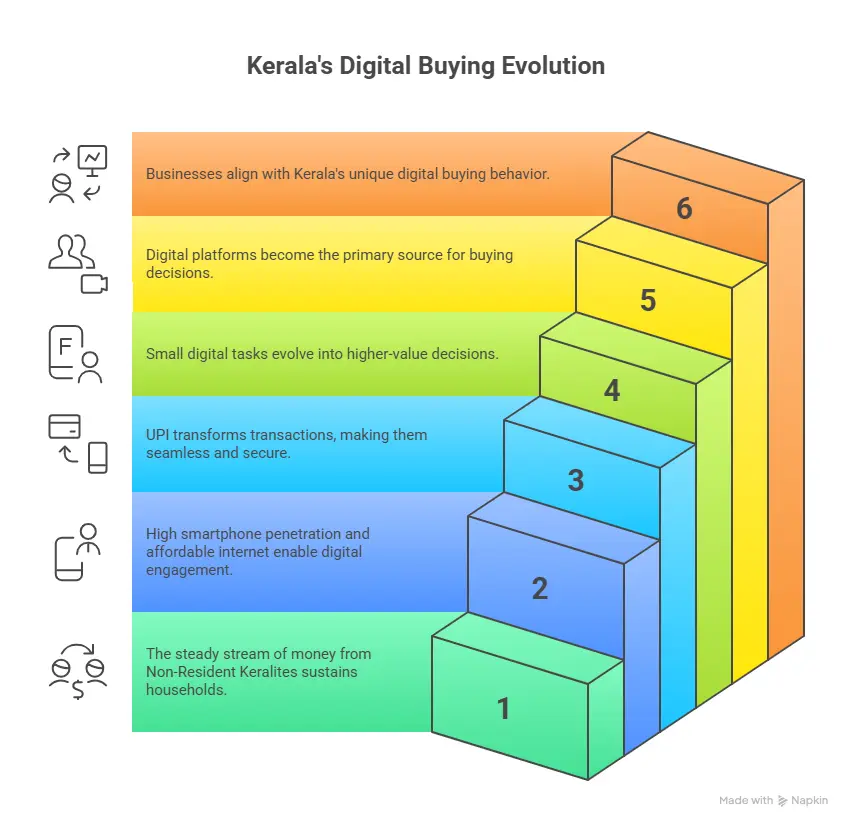
For a long time, remittance money entered Kerala as cash or bank deposits.
Spending happened offline.
Jewellery shops, local builders, appliance stores, and private institutions were the first touchpoints.
Digital played a very small role.
That situation has changed completely.
The first shift was access.
Kerala achieved high smartphone penetration faster than most Indian states. Even small towns adopted Android phones early. Internet access became affordable. Data packs became cheap.
Digital access stopped being a barrier.
The second shift was payments.
UPI transformed how people handle money. Families no longer needed to visit banks or wait for cash withdrawals. Money moved directly from accounts to merchants.
This made online transactions feel normal, not risky.
Once payment fear disappeared, exploration started.
The third shift was habit formation.
People began using digital tools for small tasks.
Recharge.
Bill payments.
Ticket booking.
Over time, these habits expanded into higher-value decisions.
Large purchases started with online research, even if the final payment happened offline.
Kerala towns adopted this behavior quietly.
Places like Perinthalmanna, Tirur, Muvattupuzha, Changanassery, and Kothamangalam now show strong digital signals. Search volumes rise. Reviews matter. Comparison happens before every major decision.
These are not metro behaviors moving outward.
They are local behaviors evolving naturally.
Remittance income accelerates this shift.
When money arrives in the account, the first step is not spending. The first step is searching.
People check options.
They compare prices.
They read reviews.
They look for reassurance.
Digital becomes the decision layer.
Another important factor is distance.
Many earners are physically outside Kerala. Decisions are discussed over calls and video chats. Screenshots, links, and reviews become part of family conversations.
Digital platforms act as a shared reference point.
This further strengthens online influence in buying decisions.
What looks like “online buying growth” is actually something deeper.
It is online decision-making growth.
That distinction matters.
What Kerala Towns Buy Online
Digital buying in Kerala towns is not random.
It follows clear patterns.
It reflects priorities shaped by remittance income, family structure, and long-term thinking.
What people buy online tells us how they think.
Electronics and Home Appliances Lead the Way
Large-ticket items dominate digital interest.
Televisions, refrigerators, washing machines, air conditioners, and smartphones show strong online research behavior. Even when the final purchase happens at a local store, the decision starts online.
People compare specifications.
They watch reviews.
They track prices for weeks.
Remittance-backed households prefer durability over discounts. They look for brands that last, not brands that trend.
Education and Skill Development Is a Priority Spend
Education has always been a core focus in Kerala.
Remittance income strengthens this further.
Parents invest in:
- Online coaching
- Skill certification programs
- Foreign exam preparation
- Career-oriented digital courses
Many of these decisions are made after long online research. Reviews, testimonials, and perceived credibility matter more than price.
Digital education platforms benefit heavily from this mindset.
Home Construction and Interior Services Go Digital First
Housing remains one of the biggest uses of remittance money.
Before meeting a contractor or architect, families now search online. They explore designs, layouts, materials, and cost ranges.
Search demand for interior designers, modular kitchens, smart home solutions, and home automation rises sharply after major remittance cycles.
Visual proof builds confidence.
Digital presence influences offline contracts.
Health and Wellness Spending Moves Online
Healthcare decisions increasingly begin online.
Families search for:
- Specialist doctors
- Premium hospitals
- Advanced treatments
- Preventive care options
Remittance-backed households are willing to spend on quality healthcare. They value expertise, infrastructure, and outcomes.
Online information reduces uncertainty before high-stress decisions.
Travel and Lifestyle Purchases Are Carefully Planned
Travel spending is not impulsive.
People research:
- Flight prices
- Holiday packages
- Resorts
- Experience-based travel
This behavior peaks around festival seasons and vacation periods. Digital planning allows families to align budgets, timing, and expectations.
Lifestyle spending grows, but it remains calculated.
Local Services Also Benefit from Digital Discovery
Not all digital buying is national or global.
Local services see strong online discovery:
- Architects
- Builders
- Interior designers
- Private tutors
- Clinics
Search engines and reviews act as filters. Only visible businesses get shortlisted.
This creates a silent advantage for digitally prepared local players.
Timing Matters More Than Discounts
In Kerala, spending follows a rhythm.
It is not random.
It is not driven by flash sales.
It is driven by timing.
Remittance money arrives in patterns.
Some families receive money monthly.
Others receive it quarterly.
Many receive larger amounts during leave periods or contract renewals.
These moments create financial confidence.
Spending decisions cluster around these periods.
Festivals amplify this effect.
Onam, Eid, Vishu, and Christmas are not just cultural events. They are financial milestones. Families plan purchases to align with these occasions.
Digital search activity rises before festivals, not during sales campaigns.
People search early.
They shortlist options.
They wait for the right moment.
Monsoon plays a role too.
During heavy rains, outdoor movement reduces. Screen time increases. Digital research intensifies, even if purchases are delayed.
This creates long research windows followed by sudden buying spikes.
Search data often shows this pattern clearly.
Interest builds gradually.
It peaks around remittance arrival or festivals.
Then it drops quickly.
This behavior confuses businesses that rely only on constant promotions.
Discounts alone do not trigger Kerala buyers.
They look for:
- Assurance
- Value
- Reliability
- Social proof
A discount without trust rarely converts.
Another important factor is collective decision-making.
Big purchases involve discussions across family members, including those living abroad. Timing allows these conversations to happen.
Digital platforms support this by providing shareable links, videos, and reviews.
Businesses that understand timing win quietly.
They prepare content early.
They build visibility before demand peaks.
They stay consistent instead of reactive.
How Platforms Adapt to Kerala’s Remittance Economy
Digital platforms rarely announce how they adapt to local markets.
But in Kerala, the signals are visible.
Platforms that succeed here adjust quietly, based on behavior, not assumptions.
One clear adaptation is payment flexibility.
Kerala users show high comfort with UPI, but for large purchases, flexibility matters more than speed. EMI options, no-cost financing, and pay-later models reduce decision friction.
This aligns well with remittance-backed spending, where money is available but decisions are cautious.
Another adaptation is language and communication.
Malayalam support is no longer optional. Interfaces, notifications, customer support, and even ad creatives increasingly use regional language cues.
This builds comfort and trust, especially among older family members involved in decisions.
Logistics also tell a story.
Delivery speed improves not just in cities, but in tier-2 towns. Warehouses and last-mile partners expand closer to remittance-heavy regions.
This reduces perceived risk.
When delivery feels predictable, digital buying feels safer.
Platforms also invest in social proof mechanisms.
Reviews, ratings, photos, and video testimonials matter more in Kerala than aggressive offers. Users spend time reading experiences, especially from people who sound local.
Trust is built peer-to-peer.
Another subtle shift is service visibility.
Local professionals who were once invisible now appear prominently online. Architects, clinics, tutors, and consultants benefit when platforms prioritize proximity and relevance over scale.
This suits Kerala’s town-based economy.
Data-driven platforms understand one thing clearly.
Kerala users may spend less frequently, but when they spend, they spend with intent. Lifetime value matters more than one-time conversion.
This changes how platforms design experiences.
What Most Kerala Businesses Miss
Many Kerala businesses see digital growth but misunderstand the reason behind it.
They assume money alone drives demand.
That assumption is costly.
A common mistake is thinking that high income leads to fast decisions.
In reality, remittance-backed households are careful. They value stability over speed. They delay purchases until they feel confident.
Pressure tactics backfire.
Another mistake is ignoring trust signals.
Businesses invest in ads but neglect credibility. No clear owner information. No real photos. No proof of work.
Kerala buyers notice this immediately.
If trust is missing, money stays in the account.
Many businesses also treat Kerala towns like metro markets.
They copy campaigns designed for Bengaluru or Mumbai. The messaging feels disconnected. The tone feels rushed.
Local context matters more than scale.
Price competition is another trap.
Discount-driven strategies attract attention but rarely build loyalty. Remittance-backed buyers prefer reliability, after-sales support, and long-term value.
Cheapest is rarely the final choice.
Some businesses ignore search behavior completely.
They focus only on social media reach. They miss the fact that most serious decisions start with search.
If a business does not appear when intent is high, it does not exist in the buyer’s mind.
The biggest mistake is lack of patience.
Kerala markets reward consistency. Brands that stay visible, informative, and transparent over time build trust naturally.
Short-term thinking kills long-term demand.
Strategic Insight for Digital Marketers and Business Owners
Remittance money changes intent, not behaviour on the surface.
People still search.
They still compare.
They still delay decisions.
But the reason behind these actions is different.
In remittance-heavy Kerala towns, digital demand is high-intent but slow-moving.
This means visibility alone is not enough. Being present at the right moment matters more than being loud all the time.
Digital strategy must respect this pace.
Search plays a central role here.
When people plan a major purchase, they turn to Google first. They look for explanations, proof, comparisons, and reassurance. This is where strong local visibility and intent-aligned content makes a difference.
This is why businesses that understand local search behaviour and user intent consistently outperform others, even with smaller budgets.
Content also plays a different role.
In fast markets, content pushes action.
In Kerala towns, content builds confidence.
Articles, service pages, and explanations act as silent salespeople. They answer questions before the customer ever calls.
This is where concepts like buyer journey mapping and intent-based content become critical.
Another key insight is patience.
Remittance-driven buyers may take weeks or months to decide. But once they decide, conversion rates are high and disputes are low.
Digital systems must support long decision cycles.
Retargeting, consistent messaging, and credibility matter more than urgency.
For marketers and business owners, the message is clear.
Do not chase trends.
Do not copy metro strategies.
Do not confuse reach with readiness.
Align your digital presence with how Kerala actually buys.
The Bigger Picture
Kerala’s digital economy did not grow because of startups or trends alone.
It grew because households had spending power, patience, and purpose.
Remittance money shaped this quietly.
When income comes from outside the state, decisions become careful. Families think long term. They seek assurance before action.
Digital platforms fit this mindset well. They provide information, comparison, and proof before commitment.
This is why Kerala towns show mature digital behaviour without aggressive marketing. People buy less often, but with more confidence.
Trust replaces urgency.
As remittance flows continue and second-generation decision-makers become more digitally fluent, this behaviour will strengthen further.
Search, content, and credibility will matter more than promotions.
Businesses that understand this reality will stay relevant.
Those who ignore it will keep wondering why demand exists but conversions do not.