
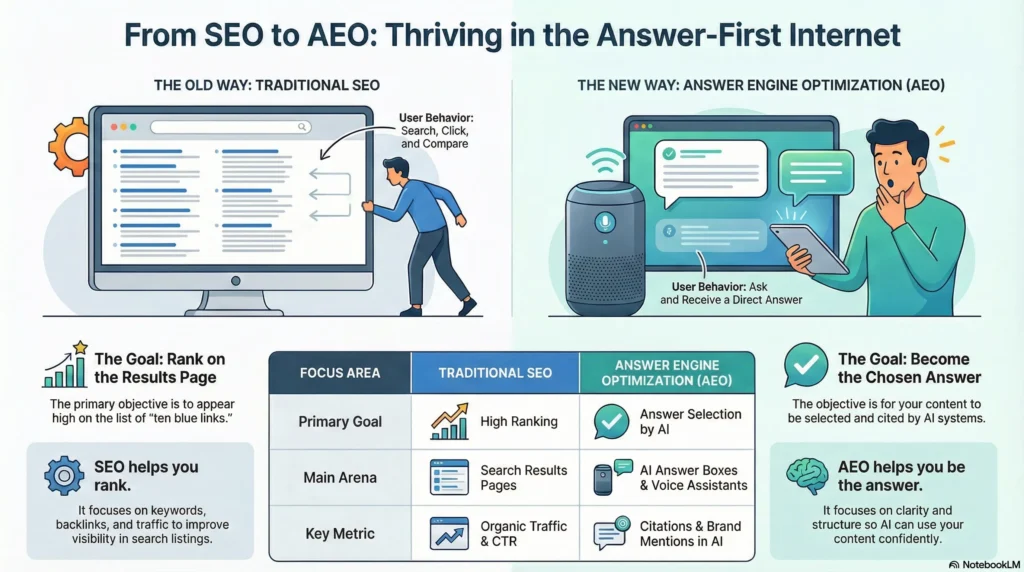
Search is changing fast. Earlier, users searched and clicked results. They read blogs and browsed many pages. Today, users ask a question and expect a direct answer.
AI tools accelerate this shift. People now use Google AI Overviews, Perplexity, ChatGPT, Gemini, and Copilot to get instant answers. The screen is no longer full of ten blue links. It is full of AI answers.
This is the start of the answer-first internet.
Traditional SEO focuses on ranking pages in search results. AEO focuses on something bigger. It aims to make your content the chosen answer inside AI results and answer engines.
In the AI era, the user behavior also changes. Users type natural language questions. They speak to voice assistants. They search using images and screenshots. They expect short, clear answers. They do not want to scroll or compare many pages.
Businesses that depend only on classic SEO face a risk. AI answers reduce clicks to websites. Many queries become zero click or single answer. Brand visibility moves from ranking positions to answer positions inside AI summaries.
By 2026, this shift becomes stronger. AI search becomes more personal, more conversational, and more multimodal. Text, voice, image, and video search merge together. Large language models use entities, knowledge graphs, and semantic understanding to generate answers.
In this new environment, Answer Engine Optimization (AEO) becomes essential.
AEO helps your content get selected, quoted, and cited by AI systems. It aligns your website with how answer engines, LLMs, and AI search systems understand topics. It connects SEO with AI technologies like embeddings, vector search, and retrieval augmented generation.
In simple words:
SEO helps you rank.
AEO helps you be the answer.
The winners in 2026 are not just the websites with more traffic. The winners are the brands that appear inside AI answers, voice responses, chat results, and knowledge panels. AEO prepares your website, your content, and your entities for this future.
What Is AEO (Answer Engine Optimization)
AEO means Answer Engine Optimization. It is the process of optimizing your content so that AI systems select it as the answer to a user’s question.
In simple words, AEO helps search engines, answer engines, and AI models clearly understand:
- who you are
- what you do
- what questions you answer
- which answer belongs to which question
Traditional SEO mainly focuses on ranking web pages in SERPs. AEO focuses on being the final answer delivered by AI systems.
Answer engines are different from classic search engines. They do not only show a list of links. They read, understand, summarize, and generate answers. Examples include:
- Google AI Overviews and SGE style results
- Perplexity
- ChatGPT with browsing
- Gemini and Microsoft Copilot
- Voice assistants and smart devices
These systems do not look at pages like humans. They use:
- large language models
- entity-based understanding
- knowledge graphs
- embeddings and vector search
- RAG pipelines
AEO aligns your content with this new way of understanding.
Clear definition
Answer Engine Optimization is the process of structuring, writing, and connecting content in a way that makes AI answer engines confidently use it as a trusted answer source.
It covers three layers:
- content clarity
- technical structure
- entity and knowledge graph signals
SEO vs AEO vs GEO
SEO answers this question:
- how to rank high in search results
AEO answers this question:
- how to become the answer inside AI results
GEO, Generative Engine Optimization, focuses on:
- how generative AI models read your content
- how to influence AI summaries, citations, and responses
They overlap, but they are not the same.
- SEO is ranking focused
- AEO is answer focused
- GEO is AI model behavior focused
AEO connects directly with:
- entity SEO
- semantic SEO
- topical authority
- programmatic SEO
- structured data and schema
Where AEO works
AEO is most visible in:
- featured snippet like results
- AI Overviews and answer cards
- People Also Ask style questions
- chat responses in AI tools
- voice search answers
- smart assistants and cars
- multimodal search systems
If your content is not answer-ready, AI may skip you, even if you rank in SEO.
What AEO requires
To succeed in AEO, your content must:
- answer specific questions clearly
- use structured formats
- include entities and definitions
- be fact-checked and consistent
- show author and brand credibility
Technically, your site must help AI systems:
- parse your content easily
- extract short answers
- map content to entities
- validate trust via signals like reviews, mentions, and citations
AEO is not about keyword stuffing. It is about knowledge clarity.
How Answer Engines Work in 2026, High-level Technical View
Answer engines in 2026 do much more than crawl and rank pages. They read, understand, connect, and generate answers.
They work in layers.
Step 1: Crawling and content collection
Like classic search engines, answer engines still:
- crawl websites
- read HTML content
- fetch PDFs, docs, and media
- understand links and sitemaps
But they also collect:
- structured data
- schema markup
- product feeds
- entity relationships
- author profiles
They do not look only at pages. They look at data and meaning.
Step 2: Converting text into machine-understandable meaning
Answer engines convert your text into:
- tokens
- vectors
- embeddings
An embedding is a mathematical representation of meaning. Two sentences with similar meaning get similar embeddings. This is the base of semantic search.
So, when a user asks a question, the system does not only match keywords. It matches meanings.
Example:
- “best phone for photography”
- “top camera mobile 2026”
Different words. Same meaning. The model understands this through embeddings.
Step 3: Knowledge graphs and entities
Modern answer engines think in entities.
An entity is a real-world thing:
- person
- company
- product
- place
- concept
For example:
- “Kochi” is an entity
- “Kerala” is an entity
- “SEO” is an entity
Your website should clearly connect to correct entities. If not, AI systems may confuse your brand with another brand.
Entity clarity is a core AEO factor.
Step 4: Retrieval Augmented Generation (RAG)
Most 2026 answer systems use RAG.
It works like this:
- user asks a question
- model searches relevant documents using vector search
- system retrieves best passages
- AI generates an answer using those passages
This means:
- passage level optimization matters
- small answer blocks matter
- clear headings matter
- FAQs and definitions matter
The engine does not always read full pages. It extracts segments.
Step 5: Ranking answers, not links
Traditional SEO ranks links.
AEO helps systems rank answers.
The engine checks:
- relevance of answer
- trust level of source
- consistency with other sources
- author and brand credibility
- recency and freshness
Then it may:
- cite your site
- quote your passage
- paraphrase your content
- or silently use your knowledge
This is why attribution and brand signals are critical.
Step 6: Multimodal answer building
2026 answer engines do not stay text-only.
They process:
- text
- audio
- video transcripts
- screenshots
- charts
- infographics
A user may upload a photo and ask a question. AI combines vision models and language models to answer.
So AEO is not only about blogs. It connects:
- images
- videos
- transcripts
- structured data
Step 7: Personalization and context
AI answer engines also use:
- user history
- location
- preferences
- past interactions
Two people asking the same question may receive different answers.
This means:
- brand presence across the web matters
- consistency across platforms matters
AEO is not just a tactic. It is brand knowledge management for AI systems.
Why AEO Is Critical in the AI Era
Search behavior is changing faster than ever. Users do not want to browse many pages. They want one clear answer. They want it now.
AI systems are built exactly for this behavior.
Users are shifting from search to answers
Earlier, users:
- searched
- scanned 10 blue links
- opened multiple tabs
- compared content
Now users:
- ask full questions
- chat with AI tools
- receive one or two answers
- stop searching further
This change reduces the number of clicks to websites.
Industry reports already show:
- increase in zero-click searches
- more answers inside search results
- higher use of AI chat tools for information
By 2026, this trend becomes normal, not experimental.
AI answers sit above SEO results
In many interfaces, AI answers appear:
- above organic results
- above ads in some cases
- in dedicated AI boxes
This means even if you rank number one in SEO, users may never scroll to you. They get their answer from the AI layer on top.
AEO helps you enter this AI layer.
Traffic patterns are changing
Classic metrics like:
- impressions
- ranking position
- CTR
do not fully explain reality now.
Brands may lose:
- clicks
- page views
but gain:
- visibility inside AI answers
- mentions in summaries
- citations by AI tools
AEO helps convert these mentions into:
- trust
- brand recall
- assisted conversions
AI models prefer structured and entity-clear content
Answer engines do not simply match keywords. They rely on:
- entities
- schema
- embeddings
- semantic similarity
If your content is not entity clear, AI systems may:
- misinterpret meaning
- mix you with another brand
- skip your content in answers
AEO reduces this risk.
Rise of voice, chat, and multimodal search
Users are not limited to typing.
They:
- talk to phones and cars
- upload images and ask questions
- use voice assistants for local business queries
- interact with AI on WhatsApp and enterprise tools
Voice results often give one answer only. There is no SERP to scroll. If you are not that answer, you are invisible.
AEO focuses exactly on this situation.
Competitive advantage in 2026
Businesses that adopt AEO early get:
- stronger entity presence
- higher chance of AI citations
- resilience against traffic drops
- better brand authority signals
Businesses that ignore AEO may experience:
- loss of organic traffic
- dependency on ads
- weaker discovery in AI tools
In simple terms:
SEO makes you visible.
AEO makes you selected.
That is why AEO is not optional in the AI era. It is a core survival strategy for publishers, SaaS, local businesses, eCommerce, and every knowledge-based industry.
AEO vs Traditional SEO vs GEO, Key Differences
SEO, AEO, and GEO are connected. But they are not the same. Each focuses on a different goal.
Understanding the difference helps you plan the right strategy for 2026.
What SEO focuses on
Traditional SEO mainly focuses on:
- ranking pages
- increasing traffic
- improving CTR
- optimizing keywords
- backlinks and authority
The target is simple. Be in the top results when someone searches.
What AEO focuses on
AEO focuses on:
- being selected as the final answer
- appearing in AI Overviews and answer boxes
- being cited inside AI chat responses
- being the spoken answer in voice assistants
The goal is not just ranking. The goal is answer selection.
What GEO focuses on
GEO means Generative Engine Optimization.
It focuses on:
- how generative AI systems read your content
- how AI produces summaries
- how AI chooses sources to cite
- how your brand appears in AI conversations
GEO is more about AI model behavior. AEO is more about answer engines in search environments.
Simple comparison view
Think like this:
- SEO → “rank my page”
- AEO → “use my answer”
- GEO → “mention my brand in AI outputs”
All three are important in the AI era.
Key differences at a glance
Below is a text-table style comparison.
Primary goal
- SEO: high ranking
- AEO: answer selection
- GEO: brand presence in AI outputs
Main place of impact
- SEO: search results pages
- AEO: AI answer boxes, voice answers, SGE style results
- GEO: AI chat tools, LLM apps, enterprise AI assistants
Optimization style
- SEO: keywords and links
- AEO: questions and answers
- GEO: training signals and AI-readable content
Measurement
- SEO: rank, CTR, organic traffic
- AEO: answer inclusion, citations, voice mentions
- GEO: AI mentions, AI referrals, brand presence in AI tools
Where they overlap
They are not enemies. They support each other.
All three benefit from:
- strong technical SEO
- fast websites
- clean code
- high-quality content
- entity optimization
- topical authority
AEO and GEO strongly depend on:
- structured data
- schema markup
- entity linking
- consistent brand signals
Why this matters in 2026
By 2026, most search systems become hybrid.
They include:
- classic ranking
- AI answers
- conversational follow-ups
So businesses need a combined strategy:
- SEO for visibility
- AEO for answer selection
- GEO for AI ecosystem presence
This is the new search triangle for the AI era.
Signals That Matter for AEO
Answer engines do not guess randomly. They use many signals to decide which content becomes the final answer. Understanding these signals is the heart of AEO.
1. Entity clarity
Entities are the backbone of AEO.
Your content must clearly define:
- who you are
- what your brand is
- what products or services you offer
- where you are located
AI systems must easily connect your brand to the correct entity in:
- knowledge graphs
- business databases
- structured datasets
If entity clarity is weak, AI may mix you with another person or company. Clear entity optimization increases your chance of becoming the answer.
2. Structured data and schema markup
Schema is a strong AEO signal.
Important schemas for AEO include:
- FAQPage
- QAPage
- HowTo
- Product
- Organization
- Person
- LocalBusiness
- Article and BlogPosting
Schema helps AI understand:
- question and answer pairs
- steps in a process
- product features and prices
- reviews and ratings
- who wrote the content
Without schema, AI needs to guess structure. With schema, understanding becomes direct.
3. Answer-oriented content structure
Answer engines prefer atomic answers.
Your page should contain:
- clear definitions
- short answer paragraphs
- bullet points
- step-by-step explanations
- comparison blocks
Long text without structure is weak for AEO. Short, precise answer blocks are strong for AEO.
4. E-E-A-T and trust signals
AI systems try to avoid fake or risky answers. So they look for:
- Experience
- Expertise
- Authoritativeness
- Trustworthiness
Strong E-E-A-T signals include:
- expert author profiles
- credentials
- company details
- privacy and contact pages
- citations and references
- consistent publishing history
Unverified or anonymous content is less likely to be selected as an AI answer.
5. Content consistency across the web
AI checks not just one page. It checks the web ecosystem.
It looks for:
- consistency of facts
- same data across profiles
- unified NAP for local businesses
- similar information across directories, social profiles, and media
If your content is inconsistent, AI loses confidence. Consistency strengthens AEO.
6. Freshness and recency
AI prefers updated information for:
- technology
- laws
- prices
- health
- fast-changing topics
Old data reduces answer confidence.
Updating content, refreshing stats, and maintaining dates supports AEO performance.
7. Technical health of the website
Technical SEO still matters.
Important factors include:
- crawlability
- clean HTML
- fast page speed
- mobile friendliness
- secure HTTPS
- low error rate
Answer engines cannot use what they cannot crawl or parse.
8. User engagement and behavior signals
Answer engines also observe:
- dwell time
- pogo-sticking behavior
- scroll depth
- satisfaction metrics from search tools
Content that users trust and stay with is more likely to be used as an answer.
9. External mentions and citations
AI does not only read your site. It reads:
- news articles
- reviews
- citations
- social mentions
- knowledge bases
If others mention your brand as an authority, your AEO strength increases.
AI and LLM-Specific Optimization, How Answer Engines Read Your Site
Answer engines in the AI era are powered by large language models, vector search, and knowledge graphs. They do not read your page like a human. They break it into meaning, structure, and signals.
To succeed in AEO, you must understand how LLMs actually “see” your content.
1. From text to embeddings
LLMs convert your content into embeddings.
An embedding is a numeric vector that represents meaning. Two pieces of content with similar meaning have similar vectors. This is how AI understands synonyms, context, and intent.
So optimization is not only for keywords. It is for semantic meaning.
Example:
- “how to renew passport in India”
- “passport renewal steps India”
Different wording. Same meaning. LLMs map both to similar embeddings.
2. Passage-level understanding, not whole pages
Traditional SEO focused on:
- title tags
- whole-page ranking
- long-form content dominance
LLMs often work at passage level.
They extract:
- one paragraph
- one list
- one definition
- one step sequence
This means:
- small answer blocks matter
- headings must be clear
- avoid mixing many ideas in one paragraph
Create content in modular chunks, not long walls of text. This directly supports AEO.
3. Retrieval before generation
Most modern systems use Retrieval Augmented Generation, RAG.
Process is simple:
- user asks a question
- system runs vector search
- top passages are retrieved
- LLM generates an answer using them
So, your content must be:
- retrievable
- relevant
- easy to quote
Hidden answers buried deep in text are weak for AEO. Clear, labelled answers are strong.
4. Canonical answers and glossaries
LLMs love canonical answers.
Examples:
- clear definitions
- short intro sentences
- glossary pages
- FAQ sections
Create:
- “What is X” blocks
- “Definition of X” blocks
- “X meaning” answers
These become training signals for answer engines.
5. Entities, not just keywords
LLMs depend heavily on entity linking.
Your site should clearly show:
- who is the author
- what brands exist
- what topics connect
- relationships between entities
Use:
- Organization schema
- Person schema
- Product schema
- SameAs links to profiles and Wikidata where appropriate
This helps AI connect your content to the correct entity in its knowledge graph.
6. Vector databases and internal search
Advanced AEO strategies use:
- vector databases
- internal semantic search
- structured knowledge hubs
These help:
- users find answers faster
- AI systems index clean, organized knowledge
For large sites, building:
- topic hubs
- knowledge bases
- documentation libraries
improves both SEO and AEO performance.
7. Multilingual and multimodal understanding
LLMs operate across languages and media.
Your answers may be:
- translated
- summarized
- spoken through voice assistants
Entity alignment across languages helps:
- regional targeting
- Indian language optimization
- Kerala market strategies
Multimodal content like:
- videos with transcripts
- podcasts with show notes
- infographics with alt text
strengthens your answer footprint.
8. Avoiding AI confusion and hallucination risks
If your content is unclear:
- AI may hallucinate details
- facts may be mixed
- wrong brands may be mentioned
Clear structure and verified claims reduce hallucination risk and increase answer selection probability.
AEO Strategies for 2026, Practical Checklist
AEO is not theory. It is practical work. You can implement it step by step. The following checklist helps you make your website answer-ready for the AI era.
A. Content-level strategies
1. Write question-first content
Start with real user questions.
Examples:
- what is
- how to
- why does
- best way to
- step by step
Use them as:
- H2 and H3 headings
- FAQ blocks
- standalone sections
2. Create clear answer blocks
Place a short, direct answer immediately after the question.
2 to 4 lines are ideal in many cases.
Then add:
- explanation
- examples
- tables
- steps
This supports passage-level retrieval by AI models.
3. Build topic hubs, not scattered posts
Group content into:
- hub and spoke structures
- knowledge hubs
- pillar pages
Connect related pages with internal links.
This strengthens topic authority and entity clarity.
4. Add FAQs to important pages
Use real questions users ask.
Avoid generic filler.
FAQ helps:
- voice answers
- featured snippet style responses
- AI overview inclusion
5. Use definitions and glossaries
Create simple definitions for key terms in your niche.
Add:
- “What is X”
- “X meaning”
- “Definition of X”
These are highly used by answer engines.
6. Keep language clear
Short sentences help AI extract answers without confusion.
Avoid unnecessary jargon and filler text.
B. Technical-level strategies
1. Implement strong schema markup
Use:
- FAQPage
- QAPage
- HowTo
- Product
- Article
- LocalBusiness
- Organization
Validate schema regularly.
Ensure it matches on-page content.
2. Optimize for passage retrieval
Use:
- strong subheadings
- short paragraphs
- bullet lists
- numbered steps
AI extracts answer chunks, not whole pages.
3. Improve crawlability and indexation
Check:
- XML sitemaps
- canonicals
- noindex issues
- JS rendering problems
If AI cannot crawl it, it cannot use it as an answer.
4. Strengthen page experience
Focus on:
- speed
- mobile usability
- HTTPS
- low CLS and LCP values
Good UX supports engagement signals used by AI.
5. Add author and organization schema
Show:
- who wrote
- who reviewed
- their credentials
It strengthens E-E-A-T and trust.
C. Brand and authority-level strategies
1. Strengthen entity presence
Make sure your brand:
- appears in trusted databases
- has consistent NAP details
- has profiles connected correctly
Use SameAs links to:
- official social pages
- Wikipedia or Wikidata when possible
2. Build digital PR and mentions
AI values:
- citations
- references
- third-party mentions
Work on:
- interviews
- podcasts
- guest articles
- expert roundups
3. Maintain consistency everywhere
Details like:
- phone numbers
- brand spelling
- service descriptions
must be same across all platforms.
Inconsistency confuses answer engines.
4. Keep content fresh
Update:
- statistics
- screenshots
- prices
- laws and regulations
Freshness is a strong AEO signal.
D. AI-assisted workflow strategies
You can use AI tools to:
- extract questions from SERPs
- cluster topics
- generate FAQ ideas
- draft structured answers
- identify entity gaps
But always:
- fact-check
- review manually
- avoid hallucinated statistics
AI supports AEO. It cannot replace expertise.
Using AI Tools to Do AEO at Scale
AEO is powerful, but it can feel heavy if you do everything manually. AI tools make the work faster, smarter, and more consistent. In 2026, successful SEO teams use AI to plan, create, structure, and monitor answer-ready content.
AI does not replace strategy. It helps you scale it.
1. Question discovery and intent mining
AI tools can analyze:
- search results
- people also ask data
- forums and communities
- customer chat logs
They help you find:
- real questions users ask
- hidden intents
- follow-up questions
You can turn these into:
- FAQs
- blog posts
- answer blocks
- glossary entries
This directly supports AEO.
2. Topic clustering and entity mapping
Large language models can:
- group related topics
- identify entities
- highlight relationships between concepts
This helps you build:
- hub and spoke content
- topic clusters
- entity-based content maps
You can see:
- which entities your brand already owns
- which entities are missing
- where to expand authority
This is essential for entity SEO and AEO.
3. Drafting answer blocks and FAQs
AI tools can draft:
- short answer blocks
- definitions
- step-by-step instructions
- pros and cons lists
You can then:
- review
- fact-check
- add expertise
This speeds up AEO content creation while keeping quality control with humans.
4. Schema generation and validation assistance
AI tools can help create:
- FAQ schema
- HowTo schema
- Product schema
- Article schema
- Organization and Person schema
They can also check:
- missing fields
- errors
- mismatched content
Structured data is one of the strongest AEO signals, and AI tools reduce the manual workload.
5. Passage optimization using AI
AI tools can scan your articles and identify:
- weak answer sections
- long unclear paragraphs
- missing definitions
- duplicate information
They can suggest:
- concise answer summaries
- better headings
- bullet lists
- clearer step sequences
This aligns content with passage-level retrieval used in RAG systems.
6. Using embeddings and vector search internally
Advanced teams go one step further.
They build:
- internal knowledge bases
- semantic site search
- vector databases for content
This helps:
- users find answers easily
- AI crawlers understand content structure
- documentation-heavy websites become AI-friendly
It also prepares your business for private AI assistants trained on your content.
7. Monitoring AI mentions and answer presence
AI tools can also track:
- brand mentions inside AI answers
- citations in AI systems
- answer presence in AI overviews
- changes in AI-generated summaries
This is the new analytics layer for 2026.
Instead of only asking:
- what is my ranking
you also ask:
- where does AI mention my brand
- in which answers am I cited
This is core AEO measurement.
8. Risks and best practices when using AI
AI increases speed, but you must avoid:
- hallucinated data
- fake statistics
- copied content issues
- loss of brand voice
Best practices:
- always review manually
- cite real sources
- keep expert oversight
- update outdated AI content
AI helps with scale. Human expertise delivers trust.
Metrics and Measurement, How to Track AEO Success
AEO changes how we measure success. Traditional SEO metrics are still useful, but they are not enough. In the AI era, answers matter more than only rankings.
You need to measure how often your content becomes the answer.
1. Classic SEO metrics still matter
You should still watch:
- impressions
- organic clicks
- ranking positions
- CTR
- engagement metrics
These show overall visibility.
But AEO success may exist even when clicks reduce. Because users may get answers from AI directly.
2. New AI era metrics to track
In AEO, you also measure:
- whether AI tools cite your content
- whether your brand is mentioned in AI answers
- whether your passages are used in summaries
- how often your site appears in AI overviews
These do not always appear in Google Analytics. You need other methods too.
3. Brand mentions inside AI answers
Track:
- how many AI chats mention your brand
- how often AI recommends your company
- how frequently your name appears in answer boxes
This shows whether AI systems trust your brand as an answer source.
4. AI referral traffic and indirect conversions
Some AI systems send traffic.
Users may:
- click citations
- search your brand name later
- visit your site directly
So watch:
- branded search volume
- direct traffic increase
- assisted conversions
Even if non-branded traffic drops, brand demand can grow through AEO.
5. Voice search answers and assistants
For voice search, the metric is simple.
You either:
- become the spoken answer
- or you are invisible
Test using:
- mobile voice assistants
- smart speakers
- in-car systems
Check whether your brand is read out when your target questions are asked.
6. Passage-level performance
Since answer engines extract passages, monitor:
- which paragraphs users copy
- scroll depth
- heatmaps
- on-page engagement
Strong answer passages often:
- reduce bounce rate
- increase time on section
- attract citations and quotes
7. SGE and AI overview visibility
As search platforms roll out AI Overviews or SGE-style systems, monitor:
- whether your pages appear in AI summaries
- which queries trigger AI overviews
- which content types get cited more
This becomes a key AEO KPI by 2026.
8. Third-party AEO and AI monitoring tools
Many tools now track:
- AI citations
- AI answer presence
- generative search visibility
- entity strength
Use them to:
- identify answer gaps
- benchmark competitors
- discover new questions to target
9. Business and revenue-level metrics
AEO is not only about visibility. It is about outcomes.
Track:
- leads
- signups
- calls
- store visits
- brand recall surveys
If your brand becomes the default answer in your niche, revenue impact follows.
10. New mindset for SEOs
The biggest change is mindset.
Earlier, SEOs asked:
- what is my position in SERP
Now AEO experts ask:
- am I the answer chosen by AI
This is the real success metric in the AI era.
AEO, Regulations, and the Future of Search, 2026 to 2030
The future of AEO is shaped not only by technology. It is also shaped by laws, copyright rules, and public debates about AI. Between 2026 and 2030, regulations are likely to change how AI tools collect data, show answers, and credit sources.
This directly affects how AEO works.
1. Copyright and AI training data debates
AI models learn from web content. Publishers, media houses, and creators are already raising questions:
- Who owns the content used for AI training
- Should AI companies pay content creators
- How should citations appear in AI answers
Court cases and policies in different countries are pushing platforms to:
- add more citations
- improve transparency
- share revenue models in some cases
If citation becomes mandatory, AEO will become even more powerful. Brands optimized for AEO will get more visibility and clicks.
2. Regulations about accuracy and safety
Governments are focusing on:
- misinformation
- deepfakes
- harmful or unsafe advice
This means AI systems must:
- rely more on trusted sources
- prefer verified experts
- avoid low-quality content
Websites with:
- strong E-E-A-T
- expert authors
- verified credentials
gain more weight inside AI answers.
AEO therefore becomes closely tied to credibility and governance, not just keywords.
3. Data privacy and personalization
Future search will be more personal.
AI tools may use:
- location
- past behavior
- preferences
- history of chats
But privacy laws will restrict how data can be used.
As a result:
- anonymized personalization will grow
- contextual answers will improve
- logged-in ecosystems may dominate
AEO strategies must respect privacy rules while still making your brand visible in personalized answers.
4. More multimodal and conversational search
From 2026 to 2030, search becomes:
- conversational
- continuous
- multimodal
Users will:
- upload images and ask questions
- talk instead of typing
- use AR or wearable devices
- get answers in cars, glasses, and smart devices
The concept of “search results page” becomes weak. The idea of “one clear answer anywhere” becomes strong.
AEO helps your brand exist in:
- chat responses
- spoken responses
- visual answers
- mixed media outputs
5. Rise of vertical answer engines
Specialized answer engines will grow in:
- health
- finance
- law
- education
- travel
- enterprise knowledge
They will use stricter rules, verified databases, and domain experts.
AEO for such engines will require:
- compliance
- certifications
- domain-specific schema
- deeper entity accuracy
Generic content will not work. Authority-focused content will.
6. Forecasts for AEO 2026 to 2030
Based on current trends, it is likely that:
- AI answer boxes become default search interface for many queries
- organic clicks decrease for informational queries
- branded search and direct traffic increase through AI exposure
- answer-level optimization becomes a core SEO skill
- entity SEO becomes mandatory
- GEO and AEO merge tightly with technical SEO
SEO professionals will need strong skills in:
- AI tools
- data analysis
- entity mapping
- content architecture
The AI era does not kill SEO. It changes its center of gravity toward answers.
Action Plan for Businesses and SEO Professionals
AEO sounds advanced, but you can start today. You do not need to change everything at once. Follow a simple, clear action plan and build step by step.
Below is a practical roadmap.
30-day AEO starter plan
Week 1 – Understand and audit
- list your top pages and keywords
- identify pages with informational intent
- find questions users ask in your niche
- check whether your site uses schema
- review entity clarity for brand and author
Output of week 1:
You know where you stand.
Week 2 – Fix structure and answers
- add clear H2 or H3 question headings
- write 2 to 4 line answer blocks
- add FAQs to key pages
- create or improve About, Contact, Author pages
- remove bulky, unclear paragraphs
Output of week 2:
Your pages become answer-friendly.
Week 3 – Add schema and entities
- implement FAQPage or QAPage schema
- add Organization and Person schema
- connect profiles using SameAs links
- fix NAP consistency for local businesses
Output of week 3:
Your site becomes machine-readable.
Week 4 – Optimize for AI and track
- test your questions in AI tools
- see whether your content is cited
- refine weak or missing answers
- update old content with new facts and stats
Output of week 4:
You start entering AI answers.
Action plan by business type
A. Local businesses
Priority areas:
- Google Business Profile accuracy
- NAP consistency across directories
- LocalBusiness schema
- service FAQs
- location-based question pages
Target questions like:
- best dentist in Kochi
- AC repair near me
- restaurant open now
Voice search matters strongly here.
B. B2B and SaaS companies
Focus on:
- product documentation
- feature explanations
- comparison content
- integration guides
Create:
- “what is” pages
- API documentation
- troubleshooting FAQs
AI tools often use this content directly in answers.
C. Publishers and education sites
Strong opportunities in:
- definitions
- glossary hubs
- how-to guides
- explainer content
Add:
- citations
- author credentials
- updated statistics
Your goal is to be the default explainer in your niche.
Skills SEO professionals must learn for AEO
To win in 2026, SEOs should build skills in:
- entity SEO
- schema and structured data
- topical authority and content architecture
- AI and LLM basics
- embeddings and vector search concepts
- data analysis and measurement
- prompt engineering for content workflows
Technical understanding gives a clear competitive edge.
Internal process changes for agencies and teams
Teams should:
- plan content around questions
- include schema in every content brief
- assign authorship and reviewer roles
- update old posts regularly
- monitor AI mentions along with rankings
This shifts the culture from “write long article” to “write clear answers with depth”.
Key mindset shift
The real action plan starts in the mind.
Earlier goal:
- get traffic from Google
New goal:
- become the answer in AI systems
When you think like this, AEO becomes natural.
Conclusion, Becoming Answer-Ready for the AI Web
The internet is moving from search-first to answer-first. Users do not want to explore ten results. They want quick, clear, trusted answers. AI tools are designed exactly for this behavior.
Traditional SEO is still important. But it is no longer enough.
Answer engines use:
- large language models
- entities and knowledge graphs
- embeddings and vector search
- RAG pipelines
They do not only rank websites. They select answers.
AEO helps your content:
- become visible inside AI answers
- get cited by AI systems
- appear in voice responses
- stay relevant in zero-click environments
In 2026 and beyond, the winners are not only the websites with high rankings. The winners are the brands that AI trusts as default sources of truth in their niche.
Becoming answer-ready means:
- clear entities
- structured content
- strong schema
- credible authors
- updated statistics
- question-driven structure
The AI era does not end SEO. It evolves it. AEO is the natural next step.
If you adapt early, you gain an advantage. If you delay, AI answers may replace your traffic before you react.
Now, let’s strengthen the article with real-world perspective.
14. Case Study Section, How AEO Changes Traffic and Visibility
This section gives practical, realistic scenarios instead of theoretical claims. Short story format. Easy to understand.
Case Study 1 – Local service business
A dental clinic in Kochi focused only on SEO.
They ranked on page one for:
- dentist in Kochi
- root canal treatment Kochi
After AI Overviews became common, users received direct answers like:
- “Best clinics for root canal in Kochi are X, Y, Z”
The clinic was not listed inside the AI answer box, even though it ranked in SEO.
They implemented AEO:
- LocalBusiness schema
- FAQ about treatments
- question-based service pages
- consistent NAP across directories
- strong About and Doctor profile entities
Result pattern seen:
- AI answers started listing them in recommendations
- rise in branded search volume
- more direct calls
- fewer website visits but more appointments
Insight:
Even with fewer clicks, business outcomes improved because the brand appeared inside AI answers.
Case Study 2 – SaaS and B2B product company
A small SaaS provider published blog posts but lacked:
- documentation
- definitions
- feature explainers
AI tools preferred citing big competitors.
They implemented AEO:
- product glossary
- “what is” and “how it works” pages
- structured FAQ for every feature
- comparison pages with entity clarity
After implementation:
- AI tools began citing their docs
- brand mentions in AI chat increased
- demo signups improved
Insight:
Answer-focused documentation helped them compete with larger brands.
Case Study 3 – Publisher and education site
An education portal published long articles with no structure.
AI tools avoided them because:
- paragraphs were too long
- no schema
- no clear answer blocks
They redesigned content with:
- headings as questions
- 2–4 line answers
- glossary hub
- author credentials
Results noticed:
- inclusion in featured snippet-like AI boxes
- increase in citations in AI answers
- new traffic from AI referrals
Insight:
Answer formatting, not just length, changed results.
What these case studies prove
Across industries:
- local
- SaaS
- education
a clear pattern appears.
When you optimize for answers:
- AI finds you
- AI trusts you
- AI recommends you
That is AEO in action.