
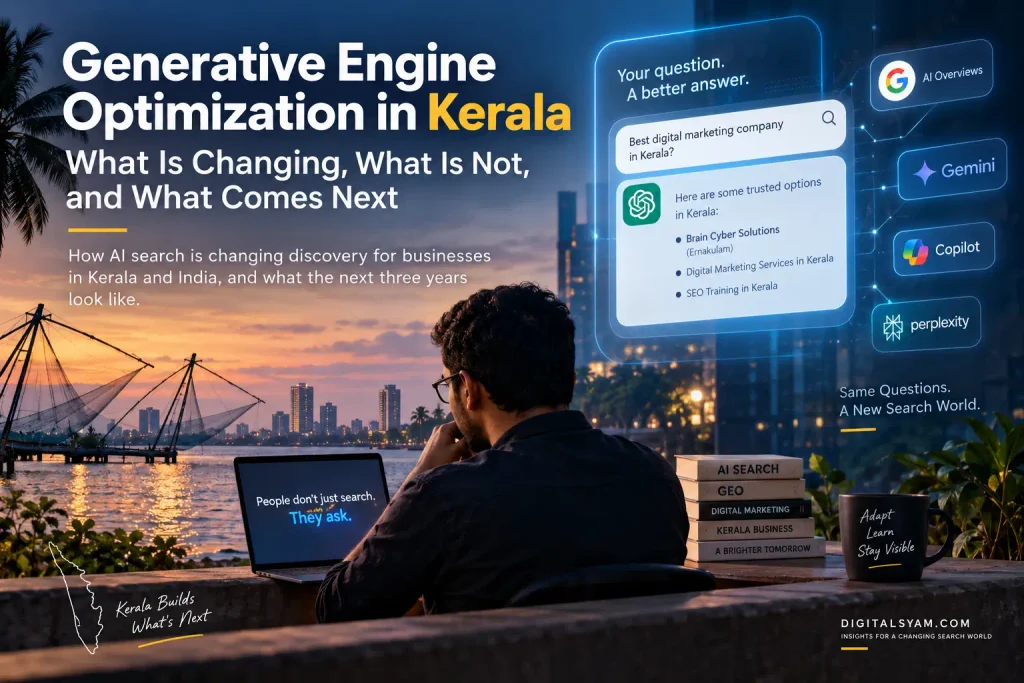
A parent in Dubai is choosing a school for their child in Kochi. They do not open Google and work through ten links. They ask an AI assistant, in Malayalam, which schools are worth considering. Three get named. The rest may as well not exist.
That scenario is illustrative, but nothing in it is speculative. Malayalam AI search is shipping, the diaspora is making these decisions remotely, and the assistants answering them are naming a handful of businesses rather than listing all of them.
This article covers what is actually changing for businesses in Kerala and India, what Generative Engine Optimization involves in practice, what remains the same as SEO has always been, and what the next three years look like.
The shift nobody in Kerala has fully priced in yet
In February 2026, Sam Altman confirmed that India had reached 100 million weekly active ChatGPT users, making it OpenAI’s second-largest market after the United States, and its largest student user base anywhere in the world. That was reported by TechCrunch in February 2026, drawing on OpenAI’s own Signals India report.
For context on how fast that happened: DataReportal’s 2026 figures show India added roughly 18 million monthly active users in twelve months, making it among the fastest-growing markets globally alongside Japan and South Korea.
Meanwhile, BCG’s November 2025 research found that 92% of Indian employees use AI at work, the highest rate anywhere in Asia Pacific.
So the adoption question is settled. Indians, including Malayalis, are already asking AI systems the questions they used to type into Google. What has not happened yet, for most businesses in Kerala, is any change in how they think about being found.
In the audits I run for clients, this shows up consistently. Businesses with reasonable Google rankings turn out to be entirely absent from AI-generated answers about their own sector, and in several cases the assistants describe them inaccurately or name a competitor instead. Nobody had checked, because until recently there was no obvious way to check.
What Generative Engine Optimization actually is
Generative Engine Optimization, usually shortened to GEO, is the practice of making a business understandable and citable by generative AI systems such as ChatGPT, Google Gemini, Perplexity, Microsoft Copilot, and Google AI Overviews.
The distinction from traditional SEO is structural rather than tactical.
Traditional SEO competes for a position in a ranked list. You appear at number three, or number seven, or on page two. Position determines how much traffic you receive, but the list itself always exists, and there is always a page two.
GEO determines whether you are referenced inside a generated answer, or absent from it. There is no position and no second page. When someone asks an AI assistant which company they should use, the system names two or three, or it names none. You are in the answer or you are invisible to that query.
This is why GEO is not “SEO with different keywords.” The unit of competition changes from a document to an entity. What gets optimised is not a page’s relevance to a phrase, but how clearly a business can be identified, described, and trusted by a system that is assembling an answer rather than retrieving a list.
GEO, AEO, and AI SEO: the terms sorted out
The vocabulary is still settling, and different people use these terms differently. The working distinctions that hold up:
Answer Engine Optimization (AEO) focuses on being the direct answer to a specific question, in featured snippets, voice results, and assistant responses. AEO is about being the answer.
Generative Engine Optimization (GEO) focuses on being understood and referenced inside AI-generated summaries and conversational responses. GEO is about being the citation.
AI SEO is the umbrella covering both, plus the separate discipline of using AI to improve SEO work itself.
The practical difference matters. AEO work concentrates on formatting: clear question-answer structure, self-contained sections, schema. GEO work concentrates on entity clarity: whether an AI system can identify your business, understand its relationships, and find consistent descriptions of it across independent sources.
Why India is not following the American pattern
Most GEO commentary available online is written from a US market perspective, and applying it directly to Kerala produces the wrong conclusions. Three differences matter.
1. India’s zero-click rate is lower, for now
In the United States, SparkToro and Datos data reported through 2026 put zero-click searches at roughly 68%, rising to 83% when an AI Overview appears. Pew Research Center’s behavioural tracking of 68,879 real searches found that 26% of users end their browsing session entirely after reading an AI Overview.
India’s numbers are lower. The reason is infrastructure rather than behaviour: Google has historically returned lighter, more traditional results pages in markets like India and Brazil, because feature-rich SERPs consume more data and processing power on cheaper devices and slower connections.
This is the single most important strategic fact in this article, and it is widely misread.
It is a delay, not an exemption. As device capability and connection quality improve, the structural pattern that has already played out in the US will play out here. Kerala businesses currently have a window that US businesses no longer have. That window is closing, and it will close without announcement.
2. India’s AI usage leads its AI spend
Nasscom’s February 2026 strategic review put domestic AI revenues at $10 to $12 billion in FY26, within a technology sector worth around $315 billion. Announced AI investment, by contrast, exceeded $200 billion in commitments pledged at the India AI Impact Summit in February 2026, with Reliance alone committing roughly $110 billion over seven years.
The gap between usage and monetisation is the defining feature of India’s AI economy right now. For a business in Kochi, the practical implication is that the audience has moved faster than the market has. People are using these tools heavily. The businesses serving them mostly have not adjusted.
3. Distribution has been deliberately engineered
OpenAI opened a New Delhi office in August 2025, launched a sub-$5 ChatGPT Go tier the same month, then made Go free for Indian users for a full year from October 2025, according to TechCrunch’s February 2026 reporting. Google matched this through distribution, striking a deal with Reliance Jio to give millions of subscribers free access to Gemini AI Pro.
This matters because it means AI assistant usage in India is not confined to early adopters or metro professionals. It has been pushed into the mainstream by design, at price points built for mass adoption.
The Malayalam question, and why it changes the calculation
This is where the Kerala picture diverges most sharply from the national one.
Google has stated, at its Google for India events, that more than 70% of internet users in India prefer communicating in their native language. IAMAI and KANTAR’s Internet in India report put active internet users at 886 million in 2024, with rural India at 488 million, or 55% of the total, a demographic reversal from a decade earlier.
Google’s own KPMG-partnered research found that 88% of Indian language internet users are more likely to respond to a message in their own language.
Two developments have made this directly relevant to AI search.
At Google for India 2024, Gemini Live was announced for Hindi with eight additional Indian languages to follow, including Malayalam. In 2026, Google expanded Search Live, part of AI Mode in Search and powered by Gemini 3.1 Flash Live, to include Malayalam among other Indian languages.
Malayalam-language AI search is no longer theoretical. It is shipping.
What this means for Kerala businesses
Three consequences follow, and none of them are obvious.
First, the competitive field in Malayalam is nearly empty. The volume of Malayalam content structured for machine retrieval is a fraction of what exists in English. An AI system asked a question in Malayalam has far fewer credible sources to draw on. That is the clearest visibility opportunity available to a Kerala business right now, and it will not stay open.
Second, the diaspora changes the geography. Kerala’s relationship with the Gulf means a substantial Malayalam-speaking audience sits outside Kerala entirely, in the UAE, Saudi Arabia, Qatar, and Oman, along with populations in Europe, North America, and Australia. Those users query AI assistants in Malayalam about Kerala businesses, services, education, healthcare, and property. Geography-based local SEO does not reach them. Entity clarity in Malayalam does.
Third, translation is not the answer. Running English content through machine translation produces text that reads as translated and carries none of the entity signals that matter. The structures that make content citable, clear definitions, consistent naming, explicit relationships, have to be built in the language, not ported into it.
I teach entirely in Malayalam, and the difference it makes is not sentimental. Technical SEO involves concepts that are difficult enough without a language barrier stacked on top. People ask more questions, ask better ones, and retain more when they are thinking in their first language. The same principle applies to content: Malayalam written as Malayalam carries meaning that Malayalam translated from English does not.
A caution on Kerala-specific data
There is no published dataset on AI assistant adoption specific to Kerala that I am aware of. The state’s high literacy rate and internet penetration make above-average adoption plausible, and the diaspora makes cross-border query volume likely, but neither is measured. Anyone quoting a Kerala-specific AI adoption figure is estimating. Treat such numbers accordingly, including any you see in marketing material.
What is actually happening to search traffic
The direction is unanimous across studies, even where the magnitude varies.
BrightEdge’s February 2026 data put AI Overviews at roughly 48% of tracked queries as per BrightEdge (“estimates range from roughly 16% to 48% depending on methodology and keyword set”), a 58% year-over-year increase. Independent CTR studies report declines ranging from 15% in Amsive’s analysis of 700,000 keywords to substantially higher figures for navigational queries, with methodology explaining much of the spread.
Bain & Company’s February 2025 consumer research found that 80% of consumers now rely on AI-generated results for at least 40% of their searches, with organic web traffic declining an estimated 15% to 25% across many sectors.
One structural change deserves particular attention. Analysis following the Gemini 3 rollout in January 2026 suggested that inclusion in AI Overviews may have partially decoupled from traditional ranking position. If that holds, it breaks an assumption most SEO work still rests on: that ranking well is sufficient to be cited. It may no longer be.
The measurement problem, and its partial solution
Until recently, AI visibility was close to unmeasurable. Two developments in 2026 changed that.
Microsoft released the AI Performance report in Bing Webmaster Tools in February 2026 and expanded it in June, adding citation counts, grounding queries, intent classification, topic groupings, and citation share. Grounding queries are worth understanding properly: they are not what a user typed, but the retrieval phrases Copilot generates internally when decomposing a conversational question into something searchable. That reveals how AI systems interpret your content, which is different information from keyword data.
Google added generative AI performance reports to Search Console in June 2026, isolating impressions from AI Overviews, AI Mode, and generative AI features in Discover. Two limits apply: the reports show impressions only, with no click, CTR, or query data, and AI Mode and AI Overviews are reported together rather than separately.
Neither tool covers ChatGPT, Perplexity, or Claude. Given that Conductor’s 2026 AEO/GEO benchmarks attribute 87.4% of AI referral traffic to ChatGPT alone, that is a significant gap, and it has to be covered by manually running baseline questions and recording the answers.
What the next three years look like
Forecasting deserves honesty about confidence levels, so each of these is marked.
High confidence: India’s zero-click rate converges upward
The infrastructure reasons for India’s lighter results pages are temporary. Device capability and connection quality are improving continuously, and there is no strategic reason for Google to maintain a differentiated experience once the constraints lift. Expect Indian zero-click behaviour to move toward US patterns over the next two to three years.
For Kerala businesses, this is the countdown that matters. Work done before convergence compounds. Work started after it is remedial.
High confidence: Malayalam AI search capability deepens
Malayalam is already supported in Gemini Live and Search Live. The direction of investment from both Google and OpenAI toward Indian language capability is consistent and well funded. Malayalam AI query volume will grow substantially.
The window for being among the few well-structured Malayalam sources is therefore finite, and probably shorter than it feels.
Moderate confidence: citation becomes a reported metric
Microsoft has already shipped citation data. Google has shipped impressions and will face pressure to add more. The direction of travel is toward AI visibility being as measurable as rankings became in the 2010s.
When that happens, the current advantage held by people who track citation manually disappears, because everyone will have the data. The advantage shifts to whoever has already built the entity structure the data measures.
Moderate confidence: the terminology consolidates
GEO, AEO, LLMO, AIO, and AI Search Optimization currently compete to describe overlapping work. One or two will win. Which one is genuinely uncertain.
The practical response is to define all of them on your own content, so that whichever term becomes standard, the association already exists.
Lower confidence: local business discovery shifts substantially
For Kerala businesses, the most consequential open question is whether AI assistants take meaningful share of local discovery, queries like finding a doctor, a school, a contractor, a restaurant.
Arguments for: assistants handle nuanced queries better than a map interface, and Indian users have shown willingness to adopt.
Arguments against: Google Maps is deeply entrenched for local intent, has real-time data assistants lack, and local search is where Google’s commercial interest is strongest.
My read is that local discovery shifts more slowly than informational and commercial research, but that research-heavy local decisions, choosing a school, a hospital, a professional service, move first. Those are exactly the categories where Kerala’s diaspora is making decisions remotely.
What to actually do about it
Five things, in order of return.
1. Fix your entity consistency before anything else
This is the highest-return work available and it is almost entirely unglamorous.
An AI system builds its picture of your business from every source it can find. If your website says one thing, your Google Business Profile says another, and a directory listing says a third, the system has no basis for a confident statement. It will either produce something vague or name a competitor whose information is consistent.
Practically: one description of your business, one founding year, one address format, one set of service names, repeated identically across your website, Google Business Profile, LinkedIn, Justdial, industry directories, and anywhere else you appear.
Contradictions are more damaging than gaps. A missing listing is neutral. A conflicting one actively prevents confident description.
This is more common than it sounds. I recently worked through this on my own properties and found a founding year stated three different ways across my website, a directory listing, and an old page on my own domain. If that happens to someone who does this professionally, it is happening to most businesses. The fix is tedious rather than difficult, which is exactly why it rarely gets done.
2. Structure entities explicitly rather than leaving them implied
Most websites leave it to search engines and AI systems to infer what the business is, what it offers, and how those things relate, from whatever the pages happen to say.
Making it explicit is better. Schema markup is the baseline. Beyond that, the EntityMap open specification, created by Fred Laurent and Dixon Jones and published under CC BY 4.0 at entitymap.org, provides a structured, machine-readable format for declaring a site’s entities and their relationships in one place rather than leaving them scattered.
I implement EntityMap on client sites and teach it in training sessions. It is not consumed natively by any search engine, and it does not claim to be. What it does is force the entity picture to be defined, consistent, and parseable, so that schema, internal linking, and content architecture all follow from one declared source rather than drifting apart.
3. Publish what only you can publish
AI systems synthesise from many sources. Content that restates what is already widely available adds nothing and gets absorbed without attribution.
Content with specifics no one else has, original data, genuine case detail, sector knowledge, local information, gets cited because it is the only source.
For a Kerala business, this usually means local and sector specificity: information about your market, your region, your industry conditions, that no national or international source holds.
4. Build corroboration outside your own website
Your own site is where you make claims. AI systems weight independent corroboration far more heavily, because self-description is the weakest possible evidence.
That means listings, professional profiles, industry directories, guest articles, podcast appearances, and press mentions, all describing your business the same way. Five independent sources agreeing is what allows a model to state something as fact.
5. Do the Malayalam work now
If your audience is Malayalam-speaking, whether in Kerala or the Gulf, structured Malayalam content is the clearest opportunity currently available in this market.
Not translated content. Content built in Malayalam with the structures that make it citable: clear definitions, consistent entity naming, question-and-answer formats, explicit relationships.
The competitive field is close to empty. It will not stay that way.
Measuring it
Rank position is the wrong metric, because generated answers do not have ranks.
Define the questions. Fifteen to twenty questions your customers would realistically ask an AI assistant, in English and Malayalam. Not keywords. Actual questions.
Baseline. Run them through ChatGPT, Perplexity, Claude, Gemini, and Google AI Overviews. Record whether your business appears, how it is described, whether the description is accurate, and which competitors are named instead.
Add the first-party data. Bing Webmaster Tools AI Performance for Copilot citations and grounding queries. Search Console generative AI reports for AI Overviews and AI Mode impressions. GA4 referral tracking for traffic arriving from AI platforms.
Re-run monthly. Progress looks like: entering answers you were previously absent from, being described more accurately, and appearing across more platforms rather than one.
This log becomes both your measurement and your evidence. Two things I have consistently found running these baselines: the platforms disagree with each other more than you would expect, so a business cited confidently by Perplexity may be invisible in ChatGPT, and the descriptions returned are often outdated rather than absent, pulled from whatever version of your information was most consistently available two years ago.
What has not changed
It is worth saying plainly, because a good deal of GEO marketing implies otherwise.
Technical foundations still determine everything. A site that cannot be crawled, renders slowly, or has a broken structure will not be cited by AI systems, for the same reason it does not rank. Content quality still matters. Authority still matters. Trust still matters.
GEO does not replace SEO. It extends it into environments where the output is an answer rather than a list. The businesses that will do well are not the ones abandoning SEO fundamentals for AI tactics. They are the ones who have the fundamentals right and have additionally made themselves legible to machines.
The future of search is not SEO versus GEO. It is understanding how they work together.
Where Kerala stands
The honest summary: Kerala businesses have a window that businesses in more mature markets have already lost, and most are not using it.
The audience has already moved. India is ChatGPT’s second-largest market. Malayalam AI search is shipping. The infrastructure reasons for India’s slower zero-click convergence are temporary and improving.
The work that matters, entity consistency, explicit structure, genuinely original content, independent corroboration, and Malayalam-language depth, takes months to compound. Starting it when convergence arrives is starting it too late.